Category: Survey

  • 100+ Trivia Questions about Myself | Fun Facts about Yourself

    100+ Trivia Questions about Myself | Fun Facts about Yourself

    Knowing more yourself empowers you to be effective; due to your deep understanding your strengths, weaknesses, makeup, traits and know how to deploy them.

    But, have you ever wondered how well your friends, family truly know you? A fun way to explore this is through Trivia Questions about yourself, a playful dive into your personality, quirks, and unique experiences.

    It’s more than just a quiz; it’s a journey of self-discovery and a chance to connect with others on a deeper level. This content guide will equip you with the knowledge and tools to create an unforgettable Trivia Questions about Me that are both engaging and revealing.

    How Do I Know the Fun Facts About Myself?

    You might be surprised how much fascinating trivia lies hidden in your daily life. Take a moment to introspect and consider these aspects:

    • Experiences: Have you traveled to unusual places? Aced a challenging skill? Witnessed a remarkable event? These experiences hold the potential for intriguing questions.
    • Habits & Quirks: Do you have an unusual collection? A peculiar morning routine? A hidden talent? Sharing these quirks can spark laughter and conversation.
    • Opinions & Preferences: What’s your most controversial food opinion? Favorite obscure movie? The book that changed your perspective? Unveiling your unique preferences can be surprisingly engaging.
    • Dreams & Aspirations: What’s your wildest dream? Your biggest fear? Your secret ambition? Sharing these vulnerabilities can build deeper connections.

    Can I Create a Good Trivia About Myself?

    Absolutely! Here are some tips to craft compelling “Trivia Questions about Me”:

    • Specificity is Key: Instead of “Do you like music?”, ask “What was the first concert I ever went to?”. Specific details make the question more engaging and reveal hidden stories.
    • Mix it Up: Combine different question types – multiple choice, true/false, fill-in-the-blank – to keep the quiz dynamic and cater to different learning styles.
    • Humor and Personal Touch: Inject your sense of humor or add a personal anecdote to each question. This makes the trivia more memorable and enjoyable.
    • Difficulty Levels: Create a mix of easy, medium, and challenging questions to keep everyone engaged, regardless of how well they know you.

    How to Prepare Good Trivia Questions About Me

    Planning is key. Here’s how to make your “Trivia questions about me to ask friends” a success:

    • Target Audience: Consider who will be answering your questions. Tailor the difficulty and topics to their knowledge and interests.
    • Theme & Structure: Decide on a theme for your trivia, like “Travel Memories” or “Childhood Adventures”. This helps guide question topics and creates a cohesive experience.
    • Visual Appeal: If presenting your trivia digitally, use visually appealing slides or images to enhance the experience.
    • Test & Feedback: Ask a friend or family member to test your questions before the big event. Their feedback can help refine the difficulty and clarity.

    Trivia Questions about Myself

    Trivia questions about Myself:

    1. What is my full name?

    ·         Sample answer: John William Smith

    2. Where was I born?

    ·         Sample answer: Los Angeles, California

    3. What is my favorite color?

    ·         Sample answer: Blue

    4. What is my zodiac sign?

    ·         Sample answer: Scorpio

    5. What is my favorite food?

    ·         Sample answer: Pizza

    6. How many siblings do I have?

    ·         Sample answer: Two

    7. What is my middle name?

    ·         Sample answer: William

    8. What is my favorite movie genre?

    ·         Sample answer: Science fiction

    9. What is my favorite hobby?

    ·         Sample answer: Playing guitar

    10.   What is my dream travel destination?

    ·         Sample answer: Japan

    11.   What is my favorite type of weather?

    ·         Sample answer: Rainy

    12.   What is my favorite type of cuisine?

    ·         Sample answer: Italian

    13.   What is my favorite fast food chain?

    ·         Sample answer: McDonald’s

    14.   What is my favorite fruit?

    ·         Sample answer: Mango

    15.   What is my favorite childhood toy?

    ·         Sample answer: Legos

    Trivia questions about me to ask friends

    16.   What is my biggest fear?

    ·         Sample answer: Heights

    17.   What was my first pet’s name?

    ·         Sample answer: Fluffy

    18.   What is my most embarrassing childhood memory?

    ·         Sample answer: Falling in front of the entire school during a play

    19.   What is my favorite childhood cartoon?

    ·         Sample answer: SpongeBob SquarePants

    20.   What is my favorite ice cream flavor?

    ·         Sample answer: Mint chocolate chip

    21.   What is my favorite TV series that I’m currently watching?

    ·         Sample answer: The Mandalorian

    22.   What is my favorite social media platform?

    ·         Sample answer: Instagram

    23.   What is my favorite type of music concert to attend?

    ·         Sample answer: Indie rock

    24.   What is my favorite place to hang out on weekends?

    ·         Sample answer: Coffee shop

    25.   What is my favorite genre of video games?

    ·         Sample answer: Role-playing games (RPGs)

    Good trivia questions about yourself

    26.   What is my favorite book?

    ·         Sample answer: “To Kill a Mockingbird” by Harper Lee

    27.   What is my favorite season?

    ·         Sample answer: Fall

    28.   What is my favorite sport to watch?

    ·         Sample answer: Basketball

    29.   What is my favorite holiday?

    ·         Sample answer: Christmas

    30.   What is my favorite music genre?

    ·         Sample answer: Alternative rock

    31.   What is my favorite type of pet?

    ·         Sample answer: Dogs

    32.   What is my favorite genre of books?

    ·         Sample answer: Mystery

    33.   What is my favorite type of shoes?

    ·         Sample answer: Sneakers

    34.   What is my favorite type of music to listen to while studying or working?

    ·         Sample answer: Classical

    35.   What is my favorite animal?

    ·         Sample answer: Penguin

    Read Also: 200+ Group Chat Survey Question Ideas (Easy, Funny and Deep)

    Fun Trivia Questions About Yourself

    36.   What is my hidden talent?

    ·         Sample answer: I can juggle

    37.   What is my favorite board game?

    ·         Sample answer: Monopoly

    38.   What is my go-to karaoke song?

    ·         Sample answer: “Don’t Stop Believin’” by Journey

    39.   What is my favorite season for fashion?

    ·         Sample answer: Spring

    40.   What is my favorite superhero?

    ·         Sample answer: Spider-Man

    41.   What is my favorite dessert topping?

    ·         Sample answer: Whipped cream

    42.   What is my favorite board game growing up?

    ·         Sample answer: Clue

    43.   What is my favorite type of sandwich?

    ·         Sample answer: Turkey and avocado

    44.   What is my favorite theme park ride?

    ·         Sample answer: Roller coasters

    45.   What is my favorite childhood TV show?

    ·         Sample answer: Pokémon

    Trivia Questions About Yourself To Ask Others

    46.   What is my favorite TV show of all time?

    ·         Sample answer: Friends

    47.   What is my favorite type of weather?

    ·         Sample answer: Rainy

    48.   What is my favorite type of cuisine?

    ·         Sample answer: Italian

    49.   What is my favorite fast food chain?

    ·         Sample answer: McDonald’s

    50.   What is my favorite fruit?

    ·         Sample answer: Mango

    51.   What is my favorite musical instrument?

    ·         Sample answer: Piano

    52.   What is my favorite genre of dance?

    ·         Sample answer: Hip-hop

    53.   What is my favorite type of coffee?

    ·         Sample answer: Cappuccino

    54.   What is my favorite outdoor activity?

    ·         Sample answer: Hiking

    55.   What is my favorite type of candy?

    ·         Sample answer: Sour gummy worms

    Trivia Questions About Yourself For Family

    56.   What was my favorite subject in school?

    ·         Sample answer: History

    57.   What is my favorite family tradition?

    ·         Sample answer: Annual camping trip

    58.   What is my favorite childhood memory with the family?

    ·         Sample answer: Building sandcastles at the beach

    59.   What is my favorite family recipe?

    ·         Sample answer: Grandma’s lasagna

    60.   What is my favorite family vacation spot?

    ·         Sample answer: Lake Tahoe

    61.   What is my favorite childhood bedtime story?

    ·         Sample answer: “Goodnight Moon”

    62.   What is my favorite family recipe to cook together?

    ·         Sample answer: Chocolate chip cookies

    63.   What is my favorite family holiday tradition?

    ·         Sample answer: Decorating the Christmas tree together

    64.   What is my favorite family game to play?

    ·         Sample answer: Charades

    65.   What is my favorite family vacation memory?

    ·         Sample answer: Road tripping across the country

    Related Post: 125+ Random Survey Questions | Types and Template

    Personal Trivia Questions About Yourself

    66.   What is my proudest achievement?

    ·         Sample answer: Graduating college with honors

    67.   What is my biggest pet peeve?

    ·         Sample answer: People chewing loudly

    68.   What is my favorite type of art?

    ·         Sample answer: Impressionism

    69.   What is my favorite type of dessert?

    ·         Sample answer: Cheesecake

    70.   What is my favorite childhood toy?

    ·         Sample answer: Legos

    71.   What is my favorite type of art medium?

    ·         Sample answer: Watercolor

    72.   What is my favorite way to relax after a long day?

    ·         Sample answer: Taking a hot bath

    73.   What is my favorite type of weather to go for a walk in?

    ·         Sample answer: Cool and crisp autumn weather

    74.   What is my favorite scent?

    ·         Sample answer: Lavender

    75.   What is my favorite childhood video game?

    ·         Sample answer: Super Mario Bros.

    Trivia Questions About Yourself To Ask Your Friends

    76.   What is my favorite TV series that I’m currently watching?

    ·         Sample answer: The Mandalorian

    77.   What is my favorite social media platform?

    ·         Sample answer: Instagram

    78.   What is my favorite type of music concert to attend?

    ·         Sample answer: Indie rock

    79.   What is my favorite place to hang out on weekends?

    ·         Sample answer: Coffee shop

    80.   What is my favorite genre of video games?

    ·         Sample answer: Role-playing games (RPGs)

    81.   What is my favorite foreign language to learn?

    ·         Sample answer: French

    82.   What is my favorite type of museum to visit?

    ·         Sample answer: Art museums

    83.   What is my favorite hobby outside of work or school?

    ·         Sample answer: Gardening

    84.   What is my favorite type of cuisine to cook at home?

    ·         Sample answer: Mexican

    85.   What is my favorite genre of podcasts?

    ·         Sample answer: True crime

    Hard Trivia Questions About Yourself

    86.   What is my shoe size?

    ·         Sample answer: 10.5

    87.   What is my favorite Shakespeare play?

    ·         Sample answer: Hamlet

    88.   What is my dream job?

    ·         Sample answer: Astronaut

    89.   What is my favorite historical era?

    ·         Sample answer: Renaissance

    90.   What is my favorite type of flower?

    ·         Sample answer: Sunflower

    91.   What is my shoe size?

    ·         Sample answer: 10.5

    92.   What is my favorite Shakespeare play?

    ·         Sample answer: Hamlet

    93.   What is my dream job?

    ·         Sample answer: Astronaut

    94.   What is my favorite historical era?

    ·         Sample answer: Renaissance

    95.   What is my favorite type of flower?

    ·         Sample answer: Sunflower

    96.   What is my favorite constellation?

    ·         Sample answer: Orion

    97.   What is my favorite type of cheese?

    ·         Sample answer: Brie

    98.   What is my favorite classic novel?

    ·         Sample answer: “Pride and Prejudice” by Jane Austen

    99.   What is my favorite flavor of tea?

    ·         Sample answer: Earl Grey

    100.What is my favorite fictional character of all time?

    ·         Sample answer: Sherlock Holmes

    Conclusion

    Unveiling Trivia Questions about Yourself is a journey of self-discovery and connection. By sharing your unique experiences, preferences, and even vulnerabilities, you create a deeper understanding and foster meaningful interactions with others.

    The most important ingredient is your genuine personality and willingness to share. So, grab a pen, unleash your creativity, and embark on the exciting adventure of turning your life into a captivating game of trivia.

    FAQs

    What are some fun questions to ask yourself?

    Am I a better person today than I was yesterday?
    What type of friend do I want to be?
    What is the most important thing I need to accomplish?
    What is the most adventurous thing I have done in life?
    What is my biggest fear in life?
    What type of person do I want to be?

    What is the best way to quiz yourself?

    Make a study guide and carry it with you so you can review the questions and answers periodically throughout the day and across several days. 

    What are some good trivia questions to ask about yourself?

    Who did you look up to as a child?
    What is your favourite hobby?
    If you could go anywhere in the world, where would it be?
    If you could only eat one type of food for the rest of your life, what would it be?
    Do you have any hidden talents?

    References

    Recommendations

  • 30+ Bachelorette Survey Questions To Curb any Drama

    30+ Bachelorette Survey Questions To Curb any Drama

    Planning a bachelorette party is a thrilling adventure, filled with laughter, memories, and celebrating the bride-to-be. But before you dive headfirst into booking flights and crafting itineraries, there’s one crucial step to take if you are going to making the party a fun experience for all. That is creating Bachelorette Survey Questions.

    This essential tool helps you gather insights from the guests, ensuring everyone’s on the same page and the party reflects the bride’s true desires.

    In this content, we shall explore further on the Bachelorette Party Survey, how to create and use it, and the Bachelorette Party Survey questions you need to spice up your night.

    What is a Bachelorette Party Survey?

    A Bachelorette Party Survey is a questionnaire designed to collect information and preferences from the bride and her bridal party to plan the perfect bachelorette bash.

    It covers various aspects like budget, location, activities, themes, and more, ensuring everyone is on the same page and excited for the celebration. Think of it as a roadmap to the bride’s dream celebration.

    How does a Bachelorette Party Survey work?

    1.     Craft Compelling Questions: Go beyond standard questions like “beach or mountains?”. Ask about the bride’s ideal party vibe (relaxing getaway, wild dance party, adventurous escapade), favorite activities (wine tasting, spa day, karaoke night), and any must-have experiences.

    2.     Consider Options & Preferences: Include multiple-choice options for popular destinations, accommodation styles, activity categories, and dietary restrictions. Open-ended questions allow for specific preferences and unique ideas.

    3.     Budget Transparency: Address finances upfront. Ask about individual budget ranges and willingness to contribute to shared expenses. This ensures financial clarity and avoids any surprises.

    4.     Spread the Fun: Share the survey electronically or host a fun-filled “survey party” with the bridal party. Encourage everyone to contribute and get excited about the upcoming celebration.

    How to conduct a Bachelorette Party Survey

    There are several ways to conduct a Bachelorette Party Survey:

    • Online Platforms: Utilize online survey tools like Google Forms, SurveyMonkey, or Typeform. These offer user-friendly interfaces, customizable questions, and data analysis features.
    • DIY Surveys: Design your own survey using a document editor like Google Docs or Microsoft Word. This gives you complete control over the questions and branding.
    • Paper Surveys: While less common, paper surveys can add a personal touch and facilitate group discussions if participants are physically present.

    Key Sections of a Bachelorette Party Survey

    • Availability & Dates: Identify suitable dates for the majority of attendees.
    • Budget Comfort: Gauge everyone’s budget range to ensure financial feasibility.
    • Location Preferences: Explore potential destinations based on interests and accessibility.
    • Activity Ideas: Gather suggestions for activities, from relaxing spa days to adventurous outings.
    • Accommodation Preferences: Determine desired hotel types, shared rooms, or individual spaces.
    • Dietary Restrictions & Allergies: Ensure everyone has access to suitable food options.
    • Dealbreakers & Dislikes: Identify activities or experiences that guests would prefer to avoid.
    • Fun & Games: Incorporate questions about the bride’s personality, preferences, and embarrassing moments for a fun “getting to know the bride” quiz.

    Bachelorette Party Survey Questions

    Bachelorette Party Survey

    1.     What is your preferred type of bachelorette party?

    ·         Spa day

    ·         Night out on the town

    ·         Weekend getaway

    2.     How do you feel about games and activities during the bachelorette party?

    ·         Love them! The more, the merrier.

    ·         Neutral, as long as they’re not too cheesy.

    ·         Not a fan, I’d rather just socialize.

    3.     What’s your favorite drink for a bachelorette party?

    ·         Champagne

    ·         Margarita

    ·         Cosmopolitan

    4.     Do you have any dietary restrictions or preferences we should consider for the party?

    ·         Vegetarian/Vegan

    ·         Gluten-free

    ·         No restrictions

    5.     How do you feel about wearing themed attire or costumes for the bachelorette party?

    ·         Absolutely! The crazier, the better.

    ·         I’m okay with it if it’s not too over-the-top.

    ·         Not really my thing.

    Bachelorette questionnaire for groom

    6.     What’s your favorite memory with your soon-to-be spouse?

    ·         Our first date at the amusement park.

    ·         Traveling together to Europe.

    ·         Just spending quiet evenings at home together.

    7.     How do you feel about the tradition of a bachelorette party?

    ·         Excited! It’s a chance to celebrate with my friends.

    ·         Nervous, but I trust my friends to plan something great.

    ·         Indifferent, I’m just going along with the tradition.

    8.     What’s something you’ve always wanted to do but haven’t had the chance to yet?

    ·         Skydiving

    ·         Learning to salsa dance

    ·         Taking a cooking class

    9.     Who is your celebrity crush?

    ·         Ryan Reynolds

    ·         Scarlett Johansson

    ·         Chris Hemsworth

    10.   What’s one thing you’ll miss most about being single?

    ·         Spontaneous adventures with friends

    ·         Having complete freedom in my schedule

    ·         Not having to compromise on plans

    Also read: 70+ Post Event Survey Questions You Should Ask After Your Next Event.

    Spicy bachelorette questions

    11.   What’s the wildest thing you’ve ever done on a night out?

    ·         Ended up dancing on stage at a club.

    ·         Tried a daredevil shot challenge with friends.

    ·         Got a spontaneous tattoo.

    12.   Have you ever had a crush on any of your partner’s friends?

    ·         Yes

    ·         No

    ·         Maybe, but I won’t say who!

    13.   What’s your most embarrassing dating moment?

    ·         Accidentally calling my date by the wrong name.

    ·         Tripping and falling in front of my crush.

    ·         Getting caught with spinach in my teeth during a romantic dinner.

    14.   If you could have a celebrity join your bachelorette party, who would it be?

    ·         Channing Tatum

    ·         Rihanna

    ·         Seth Rogen

    15.   What’s your guilty pleasure movie or TV show?

    ·         The Bachelor/Bachelorette

    ·         Keeping Up with the Kardashians

    ·         Jersey Shore

    Bachelor party survey

    16.   What’s your ideal location for a bachelor party?

    ·         Las Vegas

    ·         Caribbean cruise

    ·         Ski resort in the mountains

    17.   Do you prefer a low-key bachelor party or something more extravagant?

    ·         Low-key, just hanging out with friends.

    ·         Extravagant! Go big or go home.

    ·         Somewhere in between.

    18.   What’s your favorite type of music for a bachelor party?

    ·         Hip-hop

    Related Post: 250+ Best Birthday Trivia Questions and Answers (Easiest to Hardest)

    Bachelorette groom video questions

    19.   What’s your favorite memory with your partner so far?

    ·         Our first vacation together

    ·         Celebrating a milestone together

    ·         A simple moment of connection that meant the world

    20.   How did you know your partner was the one you wanted to marry?

    ·         There was just a feeling, like everything fell into place

    ·         Their unwavering support and understanding

    ·         It was a gradual realization over time

    21.   What’s one thing you admire most about your partner?

    ·         Their strength and resilience

    ·         Their passion and drive

    ·         Their ability to always see the best in people

    22.   How do you plan to keep the romance alive in your marriage?

    ·         Regular date nights and spontaneous gestures of affection

    ·         Open communication and honesty

    ·         Continuously making an effort to prioritize each other’s happiness

    23.   What are you most looking forward to about the wedding day?

    ·         Seeing my partner walk down the aisle

    ·         Sharing our vows and committing to a lifetime together

    ·         Dancing the night away with our friends and family

    24.   What’s one thing you’re most excited about for married life?

    ·         Starting a family together

    25.   What’s your favorite thing about your partner?

    ·         Their kindness

    26.   Describe your perfect date night with your partner.

    ·         Cooking dinner together at home and watching a movie

    27.   How do you envision your future together with your partner?

    ·         Full of love and laughter

    28.   What’s one piece of advice you’d give to your single self before meeting your partner?

    ·         Don’t settle for anything less than you deserve

    29.   What’s your favorite memory with your partner so far?

    ·         Our first vacation together

    30.   How did you know your partner was the one you wanted to marry?

    ·         There was just a feeling, like everything fell into place

    31.   What’s one thing you admire most about your partner?

    ·         Their strength and resilience

    32.   How do you plan to keep the romance alive in your marriage?

    ·         Regular date nights and spontaneous gestures of affection

    33.   What are you most looking forward to about the wedding day?

    ·         Seeing my partner walk down the aisle

    How do you play the Bachelorette Question Game?

    This fun twist involves incorporating a “Bride-to-Be” question game within the survey. Create a set of questions about the bride, her relationship, and funny anecdotes. Include multiple-choice answers with outrageous options. Share the completed surveys anonymously and have the bride guess who chose each answer. Laughter and surprises guaranteed.

    Conclusion

    By using a Bachelorette Party Survey and incorporating the Bachelorette Question Game, you can plan a celebration that reflects the bride’s personality, accommodates everyone’s preferences, and creates lasting memories for the whole group. It’s about celebrating the bride-to-be and creating an experience she’ll cherish forever. So get creative, have fun, and let the bachelorette party planning commence.

    How do you play the bachelorette question game?

    Prep your questions
    Create your game cards.
    Make an answer key.
    Hand out the game cards.
    Reveal answers and hand out prizes.

    How do I prepare for a bachelorette?

    Before setting a date or location, figure out how many people you will be inviting so you can pick dates, book accommodations, and plan activities accordingly.

    How do you discuss a bachelorette party budget?

    All attendees should share what they’re comfortable spending

    References

    Recommendations

  • 50+ Travel Survey Questions with Sample Templates

    50+ Travel Survey Questions with Sample Templates

    The world offers a vast array of cultures, sceneries, and adventures, each promising an indelible mark on your memories. But with so many options, how do you choose the destination that truly resonates with your desire to travel? This is where we appreciate the travel survey questions.

    They help you to unlock the secrets of your travel desires and guide you toward fulfilling experiences. Think of it as a conversation with your adventurous self, a chance to explore the hidden corners of your wanderlust and unearth preferences you never knew existed.

    So, in this article, you’ll discover over 50 captivating questions, meticulously categorized into themed templates. As you explore these diverse templates, you’ll not only refine your travel goals but also gain valuable insights into the fascinating world of travel itself.

    What is a Travel Survey?

    A travel survey is a research tool used to gather information about people’s travel habits, preferences, and experiences. These surveys can be conducted for a variety of purposes, including:

    Understanding travel trends: Gathering data on popular destinations, travel styles, and spending habits helps tourism boards, travel companies, and destinations tailor their offerings to better meet traveler needs.

    Improving the travel experience: Feedback from travelers can be used to identify pain points in the travel process, from booking to accommodations, and inform improvements to existing services or the development of new ones.

    Personalizing travel recommendations: By understanding people’s individual preferences and interests, travel agents, websites, and apps can curate personalized travel recommendations and offers.

    Marketing and research: Travel surveys can be used to gauge consumer sentiment towards specific destinations, brands, or campaigns, and to evaluate the effectiveness of marketing efforts.

    Academic research: Researchers in fields like tourism, sociology, and psychology can use travel surveys to study various aspects of human travel behavior, motivations, and decision-making processes.

    Travel surveys can be conducted in various formats, including online questionnaires, in-person interviews, and phone surveys. The specific questions asked will depend on the objectives of the survey and the target audience.

    Here are some of the key characteristics of a good travel survey:

    • Clear and concise questions: The questions should be easy to understand and answer, and they should avoid ambiguity or leading language.
    • Targeted audience: The survey should be directed towards a specific group of people with relevant travel experiences or interests.
    • Appropriate length: The survey should be long enough to gather necessary information but not so long that people lose interest.
    • Incentives: Offering incentives like discounts or rewards can encourage participation.
    • Data analysis: The collected data should be analyzed carefully to extract meaningful insights and inform decision-making.

    Read also: 110+ Post Training Survey Questions With Templates

    What are the Benefits of Travel Survey?

    Travel surveys offer numerous benefits for various stakeholders in the travel industry and beyond. Here are some key advantages:

    For travel service providers

    • Understand traveler preferences: Gain insights into desired destinations, travel styles, budgets, activities, and pain points. This allows tailoring offerings, amenities, and marketing strategies to better meet customer needs.
    • Measure customer satisfaction: Gauge traveler sentiment towards specific services, destinations, or overall experience. This feedback helps identify areas for improvement and ensures travelers feel valued.
    • Enhance travel recommendations: Personalize travel suggestions based on individual preferences and past experiences. This leads to higher customer satisfaction and booking rates.
    • Conduct market research: Evaluate the effectiveness of marketing campaigns, identify emerging trends, and understand competitor strategies.

    Travelers

    • Discover new destinations and experiences: Uncover hidden gems, unique activities, and travel trends based on insights from other travelers.
    • Make informed travel decisions: Get valuable recommendations, compare options, and find the best travel solutions based on specific preferences and budgets.
    • Contribute to improving the travel industry: Feedback from surveys helps shape travel offerings, infrastructure, and policies to create a more positive and efficient travel experience for everyone.

    For Researchers

    • Study travel behavior: Analyze data to understand travel motivations, decision-making processes, and the impact of travel on individuals and communities.
    • Inform policy and development: Insights from travel surveys can guide the development of policies and infrastructure related to tourism, transportation, and cultural preservation.

    Overall benefits

    • Improved travel experiences: By understanding traveler needs and preferences, the entire travel industry can work towards creating more enjoyable, seamless, and personalized travel experiences.
    • Data-driven insights: Utilizing collected data allows for evidence-based decision-making, resource allocation, and marketing strategies, leading to greater efficiency and effectiveness.
    • Knowledge sharing and collaboration: Surveys generate valuable information that can be shared across stakeholders, fostering collaboration and innovation within the travel industry.

    Note: The effectiveness of travel surveys depends on various factors, including the quality of the survey design, sampling methods, and data analysis. When done thoughtfully and ethically, travel surveys can be a powerful tool for understanding and shaping the future of travel.

    Read Also: 70+ User Experience Survey Questions With Sample Questionnaire

    What Factors do I Consider when Creating a Travel Survey?

    Crafting an effective travel survey requires careful consideration of several key factors:

    Your Objectives:

    • What information are you trying to gather? Are you aiming to understand general travel trends, gauge customer satisfaction with a specific service, or assess the effectiveness of a marketing campaign? Clearly defined objectives guide question selection and analysis.
    • Who is your target audience? Identifying your ideal participants (e.g., budget travelers, families, luxury seekers) ensures your questions resonate and generate relevant data.

    Survey Design:

    • Question types: Utilize a mix of multiple-choice, open-ended, and rating scale questions to gather diverse and insightful data. Avoid leading questions and bias.
    • Question clarity and flow: Ensure questions are concise, easy to understand, and logically ordered to maintain participant engagement.
    • Survey length: Keep it brief and focused (ideally under 10 minutes) to prevent fatigue and maximize completion rates.
    • Incentives: Consider offering discounts, rewards, or entry into sweepstakes to encourage participation.

    Data Collection and Analysis:

    • Sampling method: Select a representative sample of your target audience to ensure the generalizability of results. Popular methods include random sampling, quota sampling, and convenience sampling.
    • Data security and privacy: Implement measures to protect participant data and ensure ethical data collection practices.
    • Analysis plan: Decide on appropriate analytical methods (e.g., quantitative analysis, thematic analysis) based on your objectives and collected data types.

    Additional Considerations:

    • Accessibility: Ensure your survey is accessible to people with disabilities, including offering screen reader compatibility and alternative formats.
    • Mobile-friendliness: Design your survey for optimal viewing and completion on mobile devices, as many people access surveys on their smartphones.
    • Testing and piloting: Test your survey with a small group to identify and address any issues before widespread distribution.

    How Can I Utilize the Data from a Travel Survey?

    Utilizing data from a travel survey effectively requires a multi-pronged approach:

    Data Cleaning and Preparation:

    1. Clean the data: Address missing values, inconsistencies, and errors to ensure the accuracy and quality of your analysis.
    2. Organize the data: Structure your data into a well-organized format (e.g., using spreadsheets or statistical software) for efficient analysis.
    3. Explore the data: Describe key characteristics of the data through frequency tables, charts, and basic statistical measures.

    Data Analysis:

    1. Quantitative analysis: If your survey primarily uses closed-ended questions, utilize statistical methods like descriptive statistics, hypothesis testing, and correlation analysis to identify trends and relationships.
    2. Qualitative analysis: Analyze open-ended responses through thematic analysis, coding techniques, or sentiment analysis to uncover deeper insights and user experience narratives.
    3. Mixed-methods approach: Combine qualitative and quantitative methods for a more holistic understanding of your data, especially if your survey includes both types of questions.

    Drawing Insights and Making Decisions:

    1. Identify key findings: Summarize the most significant patterns, trends, and insights revealed by your analysis.
    2. Connect findings to objectives: Determine how these insights relate to your initial objectives and research questions.
    3. Actionable recommendations: Based on your findings, formulate practical recommendations for improving travel experiences, services, or marketing strategies.

    Sharing and Communicating Results:

    1. Create reports or presentations: Summarize your findings and recommendations in clear, concise, and visually appealing formats.
    2. Share with stakeholders: Communicate your findings with the relevant audiences, such as travel service providers, policymakers, or marketing teams.
    3. Public sharing: Consider publishing your findings (anonymously) in industry reports or academic journals to contribute to a broader knowledge of travel trends and behaviors.

    Following these steps and carefully utilizing the data you’ve collected can transform your travel survey into a valuable tool for improving travel experiences. It also aids in making informed decisions and contributing to the advancement of the travel industry.

    Read also: 250+ Best Geography Trivia Questions and Answers (Easiest to Hardest)

    Travel Survey Questions Examples

    Here are some examples of travel survey questions:

    Business Travel Survey Questions

    Business travel often plays a crucial role in growth and strategic partnerships. However, it also involves significant investment in time, resources, and budget. Understanding the experiences and pain points of business travelers empowers organizations to optimize travel policies, maximize return on investment (ROI), and improve employee satisfaction. This is where business travel survey questions come in.

    These questions aim to gather insights into:

    • Logistics and convenience: How easy was it to book flights, accommodations, and transportation? Were travel arrangements streamlined and efficient?
    • Productivity and work experience: Did the trip enable productive meetings and collaborations? Were the necessary tools and facilities readily available?
    • Cost-effectiveness: Did the trip stay within budget? Were there cost-saving opportunities that could be explored?
    • Accommodation satisfaction: Did the chosen hotels meet expectations in terms of comfort, amenities, and location?
    • Traveler well-being: Did the travel experience support employee well-being, including factors like sleep quality and work-life balance?

    By collecting data through well-crafted business travel survey questions, organizations can:

    • Identify areas for improvement: Pinpoint pain points and inefficiencies in booking processes, travel arrangements, and overall experience.
    • Make informed policy decisions: Use data to tailor travel policies to employee needs and optimize spending.
    • Boost employee satisfaction: By addressing concerns and improving travel experiences, companies can foster happier and more productive employees.
    • Increase ROI: Optimize travel expenses and extract maximum value from business trips.

    Remember, these questions are not meant to be an exhaustive list, but rather a starting point to tailor your survey to your specific needs and company culture.

    Here are Business Travel Survey Questions to get you started:

    1. On a scale of 1-5, how easy was it to book your flights and accommodations for this business trip? (1 = Extremely difficult, 5 = Extremely easy)
    2. How satisfied were you with the available technology and resources offered at your hotel/conference center? (Very dissatisfied, Somewhat dissatisfied, Neutral, Somewhat satisfied, Very satisfied)
    3. To what extent did the travel arrangements (flights, transfers, etc.) support your productivity during the trip? (Not at all supportive, Somewhat supportive, Neutral, Moderately supportive, Very supportive)
    4. Did you encounter any major challenges or inconveniences during your trip? If yes, please elaborate.
    5. Considering the purpose of your trip, do you think the chosen destination and accommodation were appropriate? (Very inappropriate, Somewhat inappropriate, Neutral, Somewhat appropriate, Very appropriate)
    6. Please rate your overall satisfaction with the cost-effectiveness of this business trip. (Very dissatisfied, Somewhat dissatisfied, Neutral, Somewhat satisfied, Very satisfied)
    7. On a scale of 1-5, how well-rested and energized did you feel during and after the trip? (1 = Very fatigued, 5 = Very well-rested)
    8. Do you have any suggestions for improving the overall business travel experience in our company?
    9. Would you recommend our current travel booking platform and process to other colleagues? (Yes, Somewhat likely, Neutral, Somewhat unlikely, No)
    10. Please share any additional feedback you have regarding your recent business trip.

    Download the Business Travel Survey Questions Template PDF

    Fun Travel Survey Questions

    Whether it’s a weekend getaway or a cross-continental expedition, travel holds the potential to create incredible memories, foster self-discovery, and ignite the spirit of adventure within us. Fun travel survey questions explore the heart of these experiences, exploring the preferences, motivations, and unique perspectives of travelers seeking experiences that go beyond the routine.

    These questions aim to tap into:

    • Travel style and preferences: Do you crave adrenaline-pumping adventures, immersive cultural experiences, or relaxing beach escapes?
    • Dream destinations and bucket list items: What hidden gems are calling your name? What adventures top your must-do list?
    • Travel companions and group dynamics: Do you prefer solo adventures, bonding with family, or creating memories with friends?
    • Unique travel experiences: What are some of the most memorable or unusual travel experiences you’ve had?
    • Impact of travel on personal growth: How has travel transformed your perspective or broadened your horizons?

    By collecting data through engaging and personalized fun travel survey questions, you can:

    • Gain valuable insights into travel trends and preferences: Understand what motivates people to travel, what experiences they seek, and what destinations top their wishlists.
    • Craft personalized travel recommendations: Use data to personalize marketing campaigns, curate unique travel experiences, and cater to specific traveler preferences.
    • Spark inspiration and encourage exploration: Ignite the wanderlust in others by sharing unique travel stories and highlighting bucket-list destinations.
    • Create a community of travel enthusiasts: Foster a sense of belonging and connection among travelers by sharing experiences and encouraging discussions.

    Here are Fun Travel Survey Questions:

    1. If you could travel anywhere in the world right now, where would you go and why?
    2. What type of travel experience excites you the most: exploring ancient ruins, indulging in luxury, or seeking adrenaline-pumping adventures?
    3. Have you ever had a travel experience that completely changed your perspective? If so, tell us about it!
    4. What’s your dream travel companion: a best friend, a romantic partner, a solo adventure, or a group of friends?
    5. Describe the most unique or unusual travel experience you’ve ever had.
    6. What hidden gem destination do you think deserves more attention and why?
    7. What’s one item on your travel bucket list that you absolutely must experience?
    8. In your opinion, what makes a travel experience truly unforgettable?
    9. If you could travel back in time to any historical period, where would you go and why?
    10. Share a funny or embarrassing travel story that you look back on and laugh about now.

    Download the Fun Travel Survey Questions Template PDF

    Read also: 50+ Leadership Survey Questions You Must Ask for Company Growth

    Corporate Travel Survey Questions

    Traveling for business purposes plays a crucial role in many organizations, fostering collaboration, securing partnerships, and driving growth. However, managing corporate travel effectively requires understanding employee preferences and ensuring policies align with both individual needs and organizational goals. This is where corporate travel survey questions come in.

    These questions delve into several crucial aspects of corporate travel experiences:

    • Policy awareness and satisfaction: Are employees aware of and understand current travel policies? How satisfied are they with the existing policies?
    • Booking process and tools: Do employees find the travel booking process convenient and user-friendly? Are the provided tools and platforms efficient and intuitive?
    • Cost management and budget adherence: Do employees feel empowered to make cost-conscious travel decisions within budget limitations?
    • Accommodation preferences and experiences: Do chosen accommodations meet employee needs in terms of comfort, amenities, and work-life balance?
    • Overall travel experience and productivity: Did the travel experience support employee well-being and contribute to achieving business objectives?

    By gathering data through thoughtfully crafted corporate travel survey questions, companies can:

    • Identify areas for improvement: Pinpoint pain points with booking processes, travel policies, and overall experience.
    • Make data-driven policy decisions: Use feedback to tailor travel policies to employee needs and optimize cost management.
    • Increase employee satisfaction and engagement: By addressing concerns and improving travel experiences, companies can foster happier and more engaged employees.
    • Boost travel program ROI: Ensure travel spend aligns with business goals and achieves maximum value.

    Remember, tailoring these questions to your specific company culture and travel program is key. Here are the Corporate Travel Survey Questions:

    1. To what extent are you aware of and understand our current corporate travel policies? (Very unaware, Somewhat unaware, Neutral, Somewhat aware, Very aware)
    2. How satisfied are you with the ease and efficiency of our travel booking platform? (Very dissatisfied, Somewhat dissatisfied, Neutral, Somewhat satisfied, Very satisfied)
    3. Do you feel empowered to make cost-conscious travel decisions within budget limitations? (Yes, Somewhat, Neutral, Not really, No)
    4. How well do the preferred hotel options align with your needs for comfort, amenities, and work-life balance during trips? (Very poorly, Somewhat poorly, Neutral, Somewhat well, Very well)
    5. Did you encounter any major challenges or inconveniences during your recent business trip? If yes, please elaborate.
    6. On a scale of 1-5, how well did the travel arrangements (flights, transfers, etc.) support your productivity during the trip? (1 = Not at all supportive, 5 = Very supportive)
    7. Do you feel that the corporate travel program contributes positively to achieving your business goals? (Strongly agree, Somewhat agree, Neutral, Somewhat disagree, Strongly disagree)
    8. What changes or improvements would you suggest for our corporate travel program?
    9. Rate your overall satisfaction with your recent business trip travel experience. (Very dissatisfied, Somewhat dissatisfied, Neutral, Somewhat satisfied, Very satisfied)
    10. Would you recommend using our current travel booking platform and processing it with your colleagues? (Yes, Somewhat likely, Neutral, Somewhat unlikely, No)
    11. Do you have any concerns or questions regarding our corporate travel policies?
    12. Please share any additional feedback you have about your recent business trip or our corporate travel program.

    Vacation Travel Survey Questions

    Vacations are more than just getaways; they’re opportunities to recharge, explore, and create lasting memories. Understanding what motivates people to choose specific destinations, activities, and travel styles can unlock valuable insights for travel professionals, tourism boards, and anyone curious about the ever-evolving world of leisure travel. This is where vacation travel survey questions come in.

    These questions delve into the heart of travel motivations and preferences, exploring:

    • Destination selection: What factors influence where people choose to vacation (weather, culture, adventure, relaxation, etc.)?
    • Travel style and budget: Do travelers prefer luxury pampering, budget-conscious backpacking, or something in between?
    • Activity preferences: What kinds of experiences do travelers seek (sightseeing, adventure, cultural immersion, culinary exploration, etc.)?
    • Travel companions: Do people prefer solo adventures, romantic getaways, family vacations, or group trips with friends?
    • Overall vacation satisfaction: What factors contribute to a truly memorable and fulfilling vacation experience?

    By collecting data through engaging and diverse vacation travel survey questions, you can:

    • Gain valuable insights into emerging travel trends: Identify popular destinations, preferred travel styles, and evolving desires of vacationers.
    • Tailor marketing and recommendations: Use data to personalize marketing campaigns, curate customized travel experiences, and suggest destinations that meet specific preferences.
    • Improve the tourism industry: Share insights with tourism boards and businesses to enhance offerings, cater to diverse needs, and improve tourist satisfaction.
    • Spark inspiration and encourage exploration: Help others discover hidden gems, unique experiences, and travel styles that align with their dreams and aspirations.

    These questions are merely a starting point, and you can adapt them to specific demographics, travel regions, or research goals.

    Here are Vacation Travel Survey Questions to get you started:

    1. What’s your dream vacation destination and why?
    2. What type of travel experience are you looking for in your next vacation: relaxation, adventure, cultural immersion, or something else?
    3. What factors are most important to you when choosing a vacation destination (budget, weather, activities, safety, etc.)?
    4. Who would you ideally travel with on your next vacation (partner, family, friends, solo, etc.)?
    5. Describe your most memorable vacation experience so far. What made it special?
    6. What hidden gem destination do you think deserves more attention and why?
    7. What kind of activities do you want to include in your next vacation?
    8. How important is the budget when planning your vacation? (Very important, Somewhat important, Neutral, Not very important, Not important at all)
    9. What are some dealbreakers for you when considering a vacation destination?
    10. What makes a vacation truly unforgettable for you? (Scenic beauty, unique experiences, cultural connections, delicious food, relaxation, etc.)
    11. If you could travel anywhere in the world with no limitations, where would you go and why?
    12. Share a funny or unexpected travel story that happened to you on vacation.

    Read also: 50+ Frequently Asked Questions About Diversity with Sample Answers

    Post Travel Survey Questions

    The journey doesn’t end when you return home. Post-travel survey questions offer valuable insights into the travelers’ experience after the dust settles, providing crucial feedback for travel service providers, destinations, and individuals seeking to improve their future travel endeavors.

    These questions explore:

    • Overall satisfaction: Did the trip meet or exceed expectations? What were the highlights and lowlights?
    • Logistics and organization: Were travel arrangements smooth and efficient? Were any aspects confusing or frustrating?
    • Destination experience: Did the destination live up to expectations? What stood out positively or negatively?
    • Accommodation and activities: Were chosen accommodations comfortable and convenient? Did chosen activities meet expectations and interests?
    • Memorable moments: What were the most memorable experiences or moments of the trip? What made them special?

    By gathering thoughtful post-travel survey questions, you can:

    • Identify areas for improvement: Gain valuable feedback on potential pain points and areas for improvement across various aspects of the travel experience.
    • Enhance future offerings: Use insights to tailor travel packages, destination recommendations, and services to better meet traveler needs and desires.
    • Measure customer satisfaction: Gain a quantitative understanding of overall satisfaction and identify areas where traveler expectations were exceeded or fell short.
    • Inform future travel planning: Help individuals reflect on their travel preferences and make informed decisions for future trips.

    Tailoring these questions to the specific trip or travel service being evaluated is crucial. Here are 12 Post Travel Survey Questions to get you started:

    1. On a scale of 1-5, how satisfied were you with your overall travel experience? (1 = Extremely dissatisfied, 5 = Extremely satisfied)
    2. What were the highlights of your trip? What experiences did you enjoy the most?
    3. Is there anything you would have changed about your itinerary or travel arrangements?
    4. Did you encounter any unexpected challenges or problems during your trip?
    5. How well did the destination meet your expectations in terms of culture, attractions, and activities?
    6. Were your accommodations comfortable, clean, and convenient?
    7. How would you rate the value for money you received on this trip? (Very poor value, Somewhat poor value, Neutral, Somewhat good value, Very good value)
    8. Would you recommend this travel service or destination to others? (Yes, Probably, Neutral, Probably not, No)
    9. What are some tips you would share with others planning a trip to this destination?
    10. What are your most memorable moments from this trip? What will you treasure the most?
    11. What did you learn about yourself or your travel preferences during this trip?
    12. Reflecting on your experience, what are your goals or priorities for your next trip?

    Download the Post Travel Survey Questions Template PDF

    FAQs

    What are the benefits of using these sample templates?

    They provide a starting point with diverse questions, categorized by theme, to inspire your survey creation and cater to specific needs.

    How can I customize these templates for my survey?

    Adapt the questions to your target audience, adjust answer options, and add your questions to address your specific research objectives.

    What are some important things to consider when creating a travel survey?

    Clearly define your objectives, choose the right sampling method, design clear and concise questions, and ensure data security and ethical practices.

    How can I utilize the data collected from a travel survey?

    Clean and analyze the data, draw insights and actionable recommendations, and share your findings with relevant stakeholders for effective utilization.

    Conclusion

    The world of travel desires is an exciting journey, and this collection offers 50+ travel survey questions in categorized templates packed with inspiration for various travel themes. From post-vacation reflections to uncovering hidden gems, these questions act as building blocks for your dynamic surveys.

    You can utilize these tips and explore the data to unlock travel trends, improve experiences, and contribute to a world where every journey holds lasting memories.

    References

    Recommendations

  • 50+ Political Survey Questions With Template

    50+ Political Survey Questions With Template

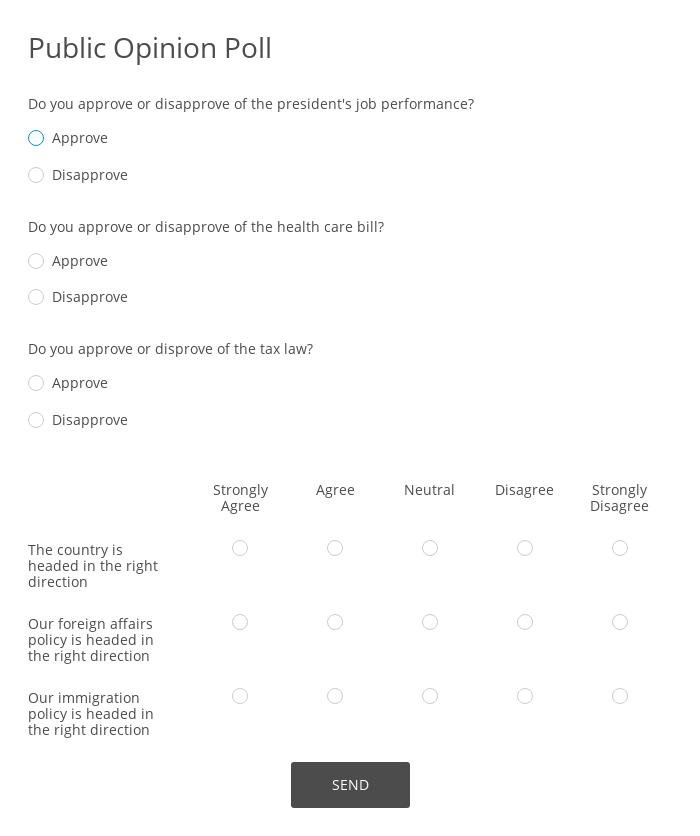
    Understanding public sentiment on political issues is crucial for candidates, policymakers, and researchers alike.

    Try out political survey questions, the tools used to gauge public opinion on a range of topics, from voting intentions to specific policies.

    This guide explores the different types of political survey questions, their uses, and how to create effective surveys for your needs.

    What are Political Survey Questions?

    Political survey questions are research questions designed to gather data about individuals’ opinions, beliefs, and attitudes on political issues, candidates, and parties. They delve into various aspects of political engagement, including:

    • Voting behavior and intentions
    • Views on specific policies and legislation
    • Trust in political institutions and figures
    • Party affiliation and political ideology
    • Awareness of current events and political debates

    Political survey questions can be administered in various formats, including:

    The choice of format depends on factors like target audience, budget, and desired level of data accuracy.

    Six Types of Political Survey Questions

    1. Demographic questions: Gather basic information like age, gender, income, and education to understand the composition of your sample.

    2. Attitudinal questions: Gauge opinions and beliefs on specific issues using scaled questions (e.g., “Strongly agree” to “Strongly disagree”) or open-ended prompts.

    3. Behavioral questions: Explore past or future voting behavior, political engagement (e.g., volunteering, attending rallies), and media consumption habits.

    4. Knowledge-based questions: Assess awareness of political events, candidates, and policies.

    5. Value-based questions: Uncover underlying values and motivations behind political beliefs.

    6. Hypothetical questions: Explore how respondents would react to different policy scenarios or candidate actions.

    Related Post: 30+ HCAHPS Survey Questions to ask your Patient

    Why give out political surveys?

    Political survey questions serve various purposes, including:

    • Campaign strategy: Identifying potential voters, understanding issues of concern, and tailoring messages accordingly.
    • Policy development: Informing policy decisions by gauging public support for different options.
    • Academic research: Studying political trends, voter behaviour, and the influence of various factors on political opinions.
    • Media reporting: Providing insights into public opinion on current events and shaping the narrative.

    How to Create a Political Survey Questionnaire:

    1. Define your target audience: Who are you trying to reach with your survey?

    2. Identify your research objectives: What specific information do you want to collect?

    3. Choose the right question types: Select question formats that align with your objectives and target audience.

    4. Ensure clear and concise wording: Avoid ambiguity and bias in your questions.

    5. Pilot test your survey: Gather feedback before launching your full survey.

    6. Choose the right survey platform: Consider online tools, phone surveys, or in-person interviews depending on your resources and target audience.

    50+ Political Survey Questions

    Political Survey Questions Examples and Sample Answers

    1.     Do you support increasing taxes on the wealthiest individuals and corporations to fund social programs?

    ·         Yes, taxing the wealthy more fairly will help address income inequality.

    ·         No, higher taxes on the wealthy will stifle economic growth and job creation.

    2.     Should the government prioritize diplomacy over military intervention in resolving international conflicts?

    ·         Yes, diplomacy should always be the first approach to resolving conflicts.

    ·         No, sometimes military intervention is necessary to protect national interests.

    3.     Do you believe healthcare should be a fundamental right guaranteed by the government?

    ·         Yes, access to healthcare is a basic human right and should be provided for all citizens.

    ·         No, healthcare is a personal responsibility, not the government’s obligation.

    4.     Do you support stricter regulations on carbon emissions to combat climate change?

    ·         Yes, urgent action is needed to address the climate crisis and protect the planet.

    ·         No, excessive regulations will hurt businesses and hinder economic growth.

    5.     Should the government provide free public education, including college tuition?

    ·         Yes, investing in education is essential for societal advancement and economic mobility.

    ·         No, individuals should be responsible for covering their education expenses.

    Good Political Survey Questions and Sample Answers

    6.     Do you support expanding social welfare programs such as food stamps and unemployment benefits?

    ·         Yes, these programs provide crucial support to vulnerable populations during times of need.

    ·         No, expanding welfare programs encourages dependency and is unsustainable.

    7.     Should there be reforms to reduce mass incarceration and address racial disparities in the criminal justice system?

    ·         Yes, reforms are necessary to promote fairness and equality within the criminal justice system.

    ·         No, maintaining tough-on-crime policies is essential for public safety.

    Top Political Survey Questions and Sample Answers

    8.     Do you believe in providing a pathway to citizenship for undocumented immigrants living in the country?

    ·         Yes, offering a pathway to citizenship is humane and benefits both immigrants and society.

    ·         No, undocumented immigrants should be deported as they are breaking the law.

    9.     Do you support stricter gun control measures, such as universal background checks and assault weapons bans?

    ·         Yes, tighter gun control laws are necessary to reduce gun violence and keep communities safe.

    ·         No, gun ownership is a constitutional right, and additional restrictions infringe upon that right.

    Related Post: 250+ Best Simpsons Trivia Questions and Answers (Easiest to Hardest)

    Questionnaire Political Survey Questions and Sample Answers

    10.   Do you support laws protecting LGBTQ+ individuals from discrimination in employment, housing, and public accommodations?

    ·         Yes, LGBTQ+ individuals deserve equal rights and protections under the law.

    ·         No, such laws infringe upon religious freedom and personal beliefs.

    11.   Should there be reforms to the electoral system, such as ranked-choice voting or abolishing the Electoral College?

    ·         Yes, electoral reforms would enhance democracy and ensure fair representation.

    ·         No, the current electoral system is effective and should not be changed.

    12.   Do you believe in increasing transparency in government operations, including making political donations and lobbying activities more accessible to the public?

    ·         Yes, transparency is essential for holding elected officials accountable and maintaining trust in government.

    ·         No, certain aspects of government operations should remain confidential for national security reasons.

    13.   Should affirmative action policies be implemented to address historical discrimination and promote diversity in education and employment?

    ·         Yes, affirmative action is necessary to level the playing field for marginalized groups and promote diversity.

    ·         No, affirmative action discriminates against individuals based on their race or gender and is unfair.

    14.   Do you support reducing government spending to lower the national debt and deficit?

    ·         Yes, reducing government spending is crucial for fiscal responsibility and long-term economic stability.

    ·         No, cutting spending could harm essential services and hinder economic growth.

    15.   Should the government prioritize protectionist policies to safeguard domestic industries, or advocate for free trade agreements to promote global commerce?

    ·         Yes, protectionist policies are necessary to protect domestic jobs and industries from unfair competition.

    ·         No, free trade agreements benefit consumers by providing access to a wider variety of goods at lower prices.

    16.   Do you support increasing surveillance measures to enhance national security and prevent terrorism?

    ·         Yes, ensuring national security is paramount, even if it means sacrificing some privacy rights.

    ·         No, excessive surveillance infringes upon civil liberties and undermines democratic values.

    17.   Should the government reform Social Security to ensure its long-term sustainability, such as raising the retirement age or adjusting benefits?

    ·         Yes, reforms are necessary to prevent Social Security from running out of funds and failing future generations.

    ·         No, Social Security should remain unchanged, and alternative solutions should be explored.

    18.   Do you support a single-payer healthcare system, where the government provides healthcare coverage for all citizens?

    ·         Yes, a single-payer system would ensure universal access to healthcare and reduce administrative costs.

    ·         No, a single-payer system would lead to decreased quality of care and long wait times for medical services.

    19.   Should education funding be increased, particularly in low-income areas, to improve educational outcomes and reduce disparities?

    ·         Yes, investing in education is crucial for fostering equality of opportunity and promoting social mobility.

    ·         No, increasing funding alone will not necessarily improve educational outcomes, and alternative solutions should be considered.

    20.   Do you support investing in renewable energy sources and implementing policies to reduce carbon emissions to combat climate change?

    ·         Yes, addressing climate change is one of the most pressing challenges of our time, and decisive action is needed.

    ·         No, the economic costs of transitioning to renewable energy outweigh the benefits, and other priorities should take precedence.

    21.   Should voting rights be expanded, such as implementing automatic voter registration and restoring voting rights to felons who have completed their sentences?

    ·         Yes, expanding voting rights strengthens democracy and ensures that all eligible citizens can participate in the electoral process.

    ·         No, voting rights should not be extended to individuals who have committed felonies, and voter registration should remain an individual responsibility.

    22.   Do you support increased regulation of large corporations to prevent monopolies, ensure consumer protection, and promote fair competition?

    ·         Yes, stronger regulations are necessary to hold corporations accountable and prevent them from exploiting consumers and workers.

    ·         No, excessive regulation stifles innovation and hinders economic growth, and market forces should be allowed to regulate corporations.

    23.   Should there be stricter ethical standards and transparency requirements for elected officials and government employees?

    ·         Yes, maintaining high ethical standards is essential for restoring public trust in government and preventing corruption.

    ·         No, existing ethics rules are sufficient, and additional regulations would create unnecessary bureaucracy.

    24.   Do you support increased government investment in infrastructure projects, such as roads, bridges, and public transportation?

    ·         Yes, investing in infrastructure creates jobs, stimulates economic growth, and improves the quality of life for citizens.

    ·         No, infrastructure projects should be funded by the private sector, and government spending should be reduced.

    25.   Should the government implement policies to address the affordable housing crisis, such as rent control and subsidies for low-income housing?

    ·         Yes, affordable housing is a basic necessity, and government intervention is needed to ensure that everyone has access to safe and affordable housing.

    ·         No, market forces should determine housing prices, and government intervention would distort the housing market and discourage investment.

    26.   Do you support legalizing or decriminalizing certain drugs, such as marijuana, to reduce incarceration rates and redirect resources to addiction treatment?

    ·         Yes, the War on Drugs has failed, and alternative approaches, such as legalization and harm reduction, are needed to address drug addiction and reduce criminalization.

    ·         No, drug legalization sends the wrong message and would increase drug abuse and addiction rates.

    27.   Should the government implement policies to promote economic development and job creation in rural areas?

    ·         Yes, rural communities deserve investment and support to thrive economically and socially.

    ·         No, rural development should be driven by market forces, and government intervention would distort the economy.

    28.   Do you support regulating big tech companies to address concerns about privacy, data security, and monopolistic behaviour?

    ·         Yes, tech companies have too much power and influence, and regulation is necessary to protect consumers and ensure fair competition.

    ·         No, government intervention in the tech industry stifles innovation and hampers economic growth.

    Cell phone political survey questions and sample Answers

    1. How likely are you to vote in the upcoming election?

    ·         Very likely

    ·         Somewhat likely

    ·         Not likely

    2. On a scale of 1 to 10, how informed do you feel about current political issues?

    ·         1 (not informed at all)

    ·         5 (somewhat informed)

    ·         10 (extremely informed)

    3. Do you prefer to receive political news and updates through text messages or social media?

    ·         Text messages

    ·         Social media

    ·         Other (please specify)

    4. Have you ever participated in a political campaign or volunteered for a political cause?

    ·         Yes

    ·         No

    5. How frequently do you engage in political discussions with friends and family?

    ·         Daily

    ·         Weekly

    ·         Rarely

    6. How do you feel about the role of technology in modern politics, such as online voting or digital campaigning? – It’s a positive advancement – It’s concerning and could lead to issues – I’m neutral on this matter

    7. Would you be willing to participate in political focus groups or surveys via your cell phone in the future? – Yes – No – Unsure

    8. How much influence do you believe social media platforms have on shaping political opinions? – A significant amount – A moderate amount – Very little to none

    9. Do you think there should be stricter regulations on political advertising on social media? – Yes – No – Unsure

    10.   How likely are you to share political content on your social media accounts? – Very likely – Somewhat likely – Not likely

    Related Post: 250+ Best SpongeBob Trivia Questions and Answers (Easiest to Hardest)

    Sample political survey questions and sample Answers

    1. What is your opinion on the current state of healthcare in the country?

    ·         It needs significant reform

    ·         It’s satisfactory

    ·         It’s excellent as it is

    2. How do you feel about the government’s handling of the economy?

    ·         Approve

    ·         Disapprove

    ·         Neutral

    3. What is your stance on immigration policies?

    ·         Support stricter policies

    ·         Support more lenient policies

    ·         Neutral

    4. Do you believe climate change is primarily caused by human activity?

    ·         Yes

    ·         No

    ·         Unsure

    5. Should there be stricter gun control laws? – Yes – No – Unsure

    6. In your opinion, what are the most pressing issues facing our country today? (Select up to three) – Economic inequality – Healthcare reform – Climate change – Immigration – National security – Education – Other (please specify)

    7. How do you rate the government’s response to the COVID-19 pandemic? – Excellent – Good – Fair – Poor – Very Poor

    8. Do you support the idea of universal basic income (UBI)? – Yes – No – Unsure

    9. How much do you trust the mainstream media as a reliable source of political information? – Completely trust – Somewhat trust – Do not trust at all

    10.   Do you believe that the current political system adequately represents the interests of all citizens? – Yes – No – Unsure

    Political Participation Survey Questions and Sample Answers

    1. Have you ever attended a political rally or protest? – Yes – No

    2. How often do you contact your elected representatives to voice your opinion on political issues? – Regularly – Occasionally – Rarely

    3. Have you ever donated money to a political campaign? – Yes – No

    4. Have you ever run for political office or considered doing so? – Yes – No

    5. How likely are you to participate in local government meetings or town halls? – Very likely – Somewhat likely – Not likely

    6. Have you ever participated in a political fundraising event? – Yes – No

    7. How often do you sign petitions related to political or social causes? – Frequently – Occasionally – Rarely

    8. Have you ever worked for a political campaign as a paid staff member? – Yes – No

    9. Do you regularly attend meetings of local political organizations or clubs? – Yes – No

    10.   Have you ever been a delegate to a political party convention? – Yes – No

    11.   How likely are you to participate in local government meetings or town halls? – Very likely – Somewhat likely – Not likely

    Political Survey Questions to ask Affiliates and sample Answers

    1. Which political party do you affiliate with? – Democratic – Republican – Independent – Other (please specify)

    2. How strongly do you identify with your political party? – Very strongly – Somewhat strongly – Not strongly at all

    3. What is the main reason you support your chosen political party? – Their stance on social issues – Their economic policies – Their leadership and values

    4. Have you ever voted for a candidate from a different political party than your own? – Yes – No

    5. Do you believe that bipartisan cooperation is important for effective governance? – Yes – No – Unsure

    6. How do you feel about the current state of the healthcare system in relation to your political party’s policies? – Satisfied – Dissatisfied – Neutral

    7. What do you think are the strengths of your political party’s platform? – Economic policies – Social justice initiatives – Foreign policy – Other (please specify)

    8. How do you think your political party can improve its appeal to a wider range of voters? – Emphasizing certain policies – Changing messaging strategies – Reaching out to different demographics

    9. Do you believe your political party adequately addresses the concerns of minority communities? – Yes – No – Unsure

    10.   How do you perceive the level of unity within your political party? – Very united – Somewhat united – Divided

    Related Post: 200+ Employee Survey Questions About Management to Improve Workplace Leadership

    Political Survey Questions to Ask Politicians and Sample Answers

    11.   What is your stance on immigration reform, and how do you plan to address it if elected?

    Sample Answer: “I believe in comprehensive immigration reform that prioritizes border security while offering a pathway to citizenship for undocumented immigrants already living in the country.”

    12.   How do you plan to tackle climate change and promote renewable energy in our region?

    Sample Answer: “I advocate for investing in green infrastructure and transitioning to renewable energy sources to combat climate change and create sustainable jobs.”

    13.   What measures do you propose to address income inequality and promote economic equity?

    Sample Answer: “I support raising the minimum wage, implementing progressive taxation, and expanding access to education and healthcare to reduce income inequality.”

    14.   What is your stance on healthcare reform, and how do you propose to improve access to affordable healthcare?

    Sample Answer: “I believe in expanding healthcare coverage and lowering prescription drug costs through measures like a public option and negotiating drug prices.”

    15.   How do you plan to address systemic racism and promote social justice in our society?

    Sample Answer: “I support criminal justice reform, police accountability measures, and investments in communities disproportionately affected by systemic racism.”

    16.   What steps will you take to protect and promote LGBTQ+ rights?

    Sample Answer: “I am committed to passing legislation that bans discrimination based on sexual orientation and gender identity and ensures equal rights for all individuals.”

    Political Ideology Survey Questions and Sample Answers

    17.   What is your position on abortion rights and reproductive healthcare access?

    Sample Answer: “I believe in a woman’s right to choose and advocate for access to safe and affordable reproductive healthcare services.”

    18.   How do you view the role of government in addressing social issues such as poverty and homelessness?

    Sample Answer: “I believe the government has a responsibility to provide social safety nets and invest in programs that lift people out of poverty and homelessness.”

    19.   What is your opinion on free trade agreements and their impact on the economy?

    Sample Answer: “I support fair trade agreements that protect workers’ rights and environmental standards while promoting economic growth and international cooperation.”

    20.   Do you identify as conservative, liberal, moderate, or another political ideology?

    Sample Answer: “I identify as a progressive, championing social justice and economic equality.”

    21.   What are your views on gun control legislation and the Second Amendment?

    Sample Answer: “I believe in common-sense gun control measures to ensure public safety while respecting individuals’ rights under the Second Amendment.”

    22.   How do you feel about government intervention in the economy?

    Sample Answer: “I believe in a mixed economy where the government plays a role in regulating industries to prevent exploitation and promote fairness.”

    Political Awareness and Political Knowledge Survey Questions and Sample Answers

    23.   Can you name the current leaders of our neighbouring countries?

    Sample Answer: “Yes, the current leaders of our neighbouring countries are [Names].”

    24.   What is the primary responsibility of the Supreme Court in the United States?

    Sample Answer: “The primary responsibility of the Supreme Court is to interpret the Constitution and ensure that laws align with its principles.”

    25.   How does the electoral college system work in presidential elections?

    Sample Answer: “The electoral college system allocates electoral votes to each state based on its representation in Congress, and the candidate who wins a majority of electoral votes becomes the president.”

    26.   Can you name the current members of the president’s cabinet?

    Sample Answer: “Yes, the current members of the president’s cabinet include [Names].”

    27.   How does the United States Congress function, and what role do senators and representatives play?

    Sample Answer: “The U.S. Congress is the legislative branch of government, consisting of the Senate and the House of Representatives. Senators and representatives draft, debate, and vote on legislation.”

    28.   What are the main differences between a democracy and a dictatorship?

    Sample Answer: “In a democracy, power is vested in the people, who elect representatives to govern on their behalf, while in a dictatorship, power is concentrated in the hands of a single ruler or ruling party.”

    Survey Questions and Sample Answers on Political Effectiveness

    29.   How will you ensure transparency and accountability in your administration?

    Sample Answer: “I will prioritize transparency by regularly communicating with constituents, holding open meetings, and disclosing financial information.”

    30.   What strategies do you have for engaging with marginalized communities and amplifying their voices in policymaking?

    Sample Answer: “I plan to establish advisory councils and community forums to ensure that marginalized communities have a seat at the table and are actively involved in decision-making processes.”

    31.   How do you plan to address political polarization and promote unity among diverse groups?

    Sample Answer: “I will strive to bridge divides by fostering respectful dialogue, seeking common ground on key issues, and promoting empathy and understanding among constituents.”

    32.   What experience or qualifications do you possess that make you an effective political leader?

    Sample Answer: “I have served as a city council member for ten years, where I successfully implemented policies to improve infrastructure and promote economic development.”

    33.   How do you plan to collaborate with opposing parties to achieve bipartisan solutions?

    Sample Answer: “I believe in finding common ground and working across party lines to address key issues facing our community, such as education and healthcare.”

    34.   What metrics will you use to evaluate the success of your policies and initiatives?

    Sample Answer: “I will assess the impact of my policies through data analysis, public feedback, and regular reviews to ensure they effectively address the needs of our constituents.”

    Related Post: 250+ Best Music Trivia Questions and Answers (Easiest to Hardest)

    Political Survey Questions Templates

    Tips for using political surveys

    • Maintain ethical practices: Ensure informed consent, anonymity, and data security.
    • Be transparent about your methodology: Explain how your survey was conducted and who funded it.
    • Weight your results: Adjust your data to represent the actual population demographics.
    • Avoid leading questions: Questions shouldn’t influence respondents towards a specific answer.
    • Analyze your data carefully: Look beyond just the numbers and identify trends and patterns.
    What are the 4 main question types?

    general or yes/no questions, questions using wh-words, choice questions, and disjunctive or tag/tail questions

    What are the 5 questions on a survey?

    how, why, who, when, and what

    How do you start a survey questionnaire?

    Write an introduction with the assumption that respondents don’t know much, if anything, about the topic of your survey

    Conclusion

    Political survey questions are powerful tools for understanding public opinion in a complex and often polarized world. By using them effectively and responsibly, you can gain valuable insights into the thoughts, feelings, and motivations of your target audience, informing your campaigns, policies, or research endeavors. The key lies in asking the right questions, collecting accurate data, and analyzing your findings with an open mind.

    References

    Recommendations

  • 30+ HCAHPS Survey Questions to ask your Patient

    30+ HCAHPS Survey Questions to ask your Patient

    Let’s talk about that infamous HCAHPS survey – you know, the one that asks you all about your hospital experience.

    But here’s the deal: it’s not just a bunch of random questions; it’s a goldmine of insights that helps hospitals up their game in patient care.

    And let’s face it, as patients, our expectations are constantly changing, so it’s crucial for healthcare providers to stay on their toes and keep improving.

    In this article, we’re diving deep into the world of HCAHPS survey questions – why they matter and which ones are absolute must-haves to make sure your healthcare experience is top-notch.

    So, grab your stethoscope (just kidding, you won’t need it) and let’s uncover the secrets to better patient care together!

    What is the HCAHPS Survey

    The Hospital Consumer Assessment of Healthcare Providers and Systems (HCAHPS) survey is a standardized tool used to measure patients’ perspectives on hospital care in the United States. It was developed by the Centers for Medicare & Medicaid Services (CMS) and the Agency for Healthcare Research and Quality (AHRQ) to assess patients’ experiences during their hospital stay.

    The HCAHPS survey consists of a set of questions that cover various aspects of the patient experience, including communication with healthcare providers, responsiveness of hospital staff, pain management, cleanliness and quietness of the hospital environment, discharge information, and overall satisfaction with the hospital.

    HCAHPS surveys are typically administered to a random sample of adult patients shortly after discharge from the hospital. Patients are asked to rate their experiences on a scale ranging from “Never” to “Always” or “Definitely No” to “Definitely Yes,” depending on the question. The survey results are then used to calculate scores for individual hospitals, which are publicly reported on the Hospital Compare website.

    The HCAHPS survey plays a crucial role in assessing and improving the quality of patient care by providing hospitals with valuable feedback from patients. It allows healthcare organizations to identify areas of strength and areas for improvement, ultimately leading to better patient outcomes and enhanced patient satisfaction.

    Check out: 250+ Best Pop Culture Trivia Questions and Answers (Easiest to Hardest)

    30+ HCAHPS Survey Questions to Ask Your Patient

    Here are over 30 HCHPS survey questions to ask your patient. These questions are grouped from easy, random, to hard, and must-asked questions.

    CMS HCAHPS Survey Questions to Ask Your Patient

    1. During your hospital stay, how often did nurses treat you with courtesy and respect?
    2. How often did nurses listen carefully to you?
    3. How often did nurses explain things in a way you could understand?
    4. How often did nurses respond quickly when you pressed the call button for help?
    5. During your hospital stay, how often did doctors treat you with courtesy and respect?
    6. How often did doctors listen carefully to you?
    7. How often did doctors explain things in a way you could understand?
    8. How often did doctors involve you in decisions about your care?
    9. How often were your pain levels well-controlled during your hospital stay?
    10. How often did hospital staff do everything they could to help you with your pain?
    11. How often was your room kept clean during your hospital stay?
    12. How often was the area around your room quiet at night?
    13. How often did hospital staff explain what to do if you had pain?
    14. How often did hospital staff explain the purpose of your medications?
    15. How often did hospital staff explain the possible side effects of your medications?
    16. How often were your discharge instructions explained to you before you left the hospital?
    17. How often did hospital staff tell you what to do if you had any problems or questions after leaving the hospital?
    18. How often did you receive help as soon as you wanted when you needed it during your hospital stay?
    19. How often did hospital staff treat you with dignity and respect?

    Must-Ask HCAHPS Survey Questions to Ask Your Patient

    1. How often did hospital staff include you in decisions about your care?
    2. How often did you receive care from doctors or nurses who worked together as a team?
    3. How often did hospital staff take your preferences and those of your family into account in your care and treatment?
    4. How often were you kept informed about delays in your treatment or tests?
    5. How often were the hospital staff responsive to your needs?
    6. How often did hospital staff explain what was going to happen during your treatment or procedure in a way you could understand?
    7. How often did hospital staff discuss your treatment options and preferences with you?
    8. How often did you feel that hospital staff cared about you as a person?
    9. How often did hospital staff involve you in decisions about your care as much as you wanted?
    10. How often did hospital staff ask if you had any concerns or worries about your care?
    11. How often did you feel that you were treated with kindness and compassion during your hospital stay?

    Check out this related content: 150+ Easy-to-Answer Trivia Questions to Spice Up Your Night

    Easy HCAHPS Survey Questions to Ask Your Patient

    1. How often did nurses treat you with courtesy and respect during your hospital stay?
    2. How often did nurses listen carefully to you?
    3. How often did nurses explain things in a way you could understand?
    4. How often did doctors treat you with courtesy and respect?
    5. How often did doctors listen carefully to you?
    6. How often did doctors explain things in a way you could understand?
    7. How often did hospital staff respond quickly when you pressed the call button for help?
    8. How often was your room kept clean during your hospital stay?
    9. How often was the area around your room quiet at night?
    10. How often did hospital staff explain what to do if you had any problems or questions after leaving the hospital?

    Check out this related content: 250+ Best Pop Culture Trivia Questions and Answers (Easiest to Hardest)

    Random HCAHPS Survey Questions to Ask Your Patient

    1. How often did hospital staff explain what was going to happen during your treatment or procedure in a way you could understand?
    2. How often did hospital staff involve you in decisions about your care as much as you wanted?
    3. How often did you receive care from doctors or nurses who worked together as a team?
    4. How often were you kept informed about delays in your treatment or tests?
    5. How often were the hospital staff responsive to your needs?
    6. How often did hospital staff discuss your treatment options and preferences with you?
    7. How often did you feel that hospital staff cared about you as a person?
    8. How often did hospital staff ask if you had any concerns or worries about your care?
    9. How often did you feel that you were treated with kindness and compassion during your hospital stay?
    10. How often were your discharge instructions explained to you before you left the hospital?

    For the most fun, read also: 250+ Best Trivia Questions For Teens With Answers

    Hard HCAHPS Survey Questions to Ask Your Patient

    1. How often did hospital staff effectively address any cultural or language barriers that affected your care?
    2. How often did you feel that hospital staff respected your privacy and confidentiality during your hospital stay?
    3. How often were your preferences for pain management taken into consideration by hospital staff?
    4. How often did hospital staff proactively address any concerns or complaints you had during your hospital stay?
    5. How often did you feel that hospital staff provided emotional support and empathy during difficult moments?
    6. How often were you actively involved in creating and updating your care plan during your hospital stay?
    7. How often did hospital staff ensure that your nutritional and dietary preferences were accommodated during your hospital stay?
    8. How often did hospital staff effectively address any physical discomfort or discomfort-related concerns you had?
    9. How often did you feel that hospital staff were knowledgeable and competent in addressing your medical needs and concerns?
    10. How often did hospital staff effectively communicate with your family or caregivers regarding your care and treatment?

    Check out this related content: 250+ Best Disney Trivia Questions and Answers

    Why is the HCAHPS Survey Important?

    The Hospital Consumer Assessment of Healthcare Providers and Systems (HCAHPS) survey holds significant importance for several reasons:

    • Patient-Centered Care: The HCAHPS survey focuses on patients’ perspectives and experiences during their hospital stay, making it a crucial tool for assessing the quality of patient-centered care. By capturing patients’ feedback, healthcare providers can better understand patients’ needs and preferences, leading to improved care delivery.
    • Quality Improvement: HCAHPS survey results provide valuable insights into the strengths and weaknesses of hospital care delivery. Hospitals can use this feedback to identify areas for improvement and implement targeted strategies to enhance patient care, safety, and satisfaction.
    • Accountability and Transparency: Public reporting of HCAHPS survey scores on the CMS or any other Hospital Compare website promotes accountability and transparency in healthcare. Patients can access information about hospitals’ performance and make informed decisions about their healthcare providers based on reported scores.
    • Reimbursement and Incentives: HCAHPS survey results are tied to reimbursement incentives for hospitals participating in Medicare programs. Hospitals with higher scores may receive financial incentives, while those with lower scores may face penalties. This incentivizes hospitals to prioritize patient satisfaction and continuously improve care quality.
    • Benchmarking and Comparison: HCAHPS survey data allows hospitals to benchmark their performance against national and regional averages, as well as against peer institutions. This enables hospitals to identify best practices and areas where they may lag behind, facilitating peer learning and collaboration.
    • Patient Engagement: The CMS HCAHPS survey encourages patient engagement by giving patients a voice in assessing the quality of their care. Patients feel empowered when their opinions are valued, leading to increased satisfaction and trust in the healthcare system.

    For the most fun, read also: 250+ Best Trivia Questions For Teens With Answers

    How can healthcare providers use HCAHPS survey results to improve patient care?

    Healthcare providers can leverage HCAHPS survey results in several ways to improve patient care:

    • Identify Areas for Improvement: Analyze survey data to identify specific areas where patients report lower satisfaction scores or highlight concerns. Common areas for improvement may include communication with healthcare providers, cleanliness of facilities, pain management, and discharge instructions.
    • Implement Targeted Interventions: Develop and implement targeted interventions aimed at addressing identified areas for improvement. For example, if patients consistently report dissatisfaction with communication, hospitals can implement training programs for staff to improve communication skills or enhance communication tools and processes.
    • Enhance Staff Training and Education: Use survey feedback to identify training needs for healthcare providers and staff. Provide training sessions or workshops focused on topics such as effective communication, empathy, cultural competency, and patient-centered care to improve patient interactions and experiences.
    • Promote Patient Engagement: Actively involve patients in their care by soliciting feedback, addressing concerns, and incorporating patient preferences into treatment plans. Encourage patients to ask questions, voice their concerns, and actively participate in decision-making processes related to their care.
    • Enhance Facilities and Amenities: Use survey feedback to make improvements to hospital facilities and amenities to create a more comfortable and welcoming environment for patients. This may include upgrades to patient rooms, waiting areas, signage, and amenities such as food services and entertainment options.
    • Monitor Progress and Track Outcomes: Continuously monitor HCAHPS survey scores over time to track progress and evaluate the effectiveness of interventions implemented to improve patient care. Regularly reviewing survey data allows healthcare providers to assess trends, identify areas of improvement, and make adjustments as needed.

    Check out this related content: 250+ Best Disney Trivia Questions and Answers

    When should HCAHPS surveys be administered to patients?

    HCAHPS surveys should be administered to patients shortly after discharge from the hospital. The timing of survey administration is critical to ensure that patients’ experiences are fresh in their minds and accurately captured.

    Administering the survey shortly after discharge allows patients to provide feedback on their entire care experience, including interactions with healthcare providers, the quality of care received, and the overall hospital environment.

    Typically, HCAHPS surveys, especially for CMS are sent to patients via mail, email, or phone within a few days to a few weeks after discharge. Hospitals may also choose to administer surveys electronically during a patient’s hospital stay or shortly after discharge using tablet devices or online platforms.

    Healthcare providers need to strike a balance between administering the survey promptly to capture timely feedback and allowing patients sufficient time to reflect on their experiences and provide thoughtful responses.

    Additionally, hospitals should ensure that survey administration methods are accessible and convenient for patients, taking into account factors such as language preferences and technological literacy.

    For the most fun, read also: 250+ Best Taylor Swift Trivia Questions and Answers (Easiest to Hardest)

    Conclusion

    In conclusion, the HCAHPS survey, including the one administered by CMS is a valuable tool for capturing patients’ perspectives on hospital care.

    By asking patients the right questions, healthcare providers can gain valuable insights into their experiences and identify opportunities for improvement.

    By prioritizing patient-centred care and actively seeking feedback through the HCAHPS survey, healthcare organizations can enhance the quality of care and ultimately improve patient outcomes.

    Check out this related content: 250+ Best Taylor Swift Trivia Questions and Answers (Easiest to Hardest)

    Frequently Asked Questions

    What is the HCAHPS survey, and why is it important?

    The HCAHPS survey is a standardized questionnaire designed to measure patients’ perceptions of their hospital experience. It covers various aspects of care, including communication with healthcare providers, responsiveness of staff, cleanliness, and overall satisfaction.

    What types of questions are included in the CMS HCAHPS survey?

    The HCAHPS survey includes questions related to communication with doctors and nurses, pain management, responsiveness of hospital staff, cleanliness and quietness of the hospital environment, discharge information, and overall rating of the hospital.

    How can healthcare providers use HCAHPS survey results to improve patient care?

    Healthcare providers can use HCAHPS survey results to identify areas of strength and areas for improvement in patient care. By analyzing survey data, hospitals can implement targeted interventions to address specific issues raised by patients.

    When should the CMS HCAHPS surveys be administered to patients?

    HCAHPS surveys are typically administered to patients shortly after discharge from the hospital. This timing allows patients to provide feedback on their entire care experience, from admission to discharge.

    How can healthcare providers encourage patients to participate in the CMS HCAHPS survey?

    Healthcare providers can encourage patients to participate in the HCAHPS survey by emphasizing the importance of their feedback in improving patient care.

    References

    Recommendations

  • 200+ Employee Survey Questions About Management to Improve Workplace Leadership

    200+ Employee Survey Questions About Management to Improve Workplace Leadership

    In today’s competitive work environment, attracting and retaining top talent is crucial. One key factor that influences employee satisfaction and engagement is the quality of their management.

    Effective leadership is like the engine of a company, driving performance and employee satisfaction. Yet, how do you know if your management team is firing on all cylinders?

    Gathering feedback through employee survey questions about management is a powerful tool for organizations to understand their leaders’ strengths and weaknesses, identify areas for improvement, and ultimately, create a more positive and productive work environment.

    This article captures over 200+ Employee Survey Questions About Management to Improve Workplace Leadership. Carefully read through!

    Why is Feedback on Management Vital?

    Open and honest feedback serves as a compass, guiding organizations towards improved leadership practices. Employee survey about management provides invaluable insights that go beyond individual performance reviews. It allows you to:

    • Assess leadership effectiveness: Understand how employees perceive their managers’ ability to lead, motivate, and inspire.
    • Identify areas for improvement: Pinpoint specific areas where managers can develop their skills and approach to leadership.
    • Boost employee engagement: Show employees that their opinions matter and that you’re committed to creating a positive work experience.
    • Improve communication: Open a dialogue between managers and employees, fostering better understanding and collaboration.
    • Reduce turnover: When employees feel valued and heard, they’re more likely to stay with the company.

    What’s the Goal of a Manager Evaluation Survey?

    The primary goal of an employee survey about management is not to point fingers, but to gather constructive feedback for actionable change. It’s about creating a safe space for honest opinions and suggestions. This type of survey aims to:

    • Evaluate leadership effectiveness: Assess key leadership competencies like communication, decision-making, and delegation.
    • Identify areas for improvement: Pinpoint specific aspects of management that require attention.
    • Measure employee sentiment: Gauge overall satisfaction with management style and support.
    • Gather actionable insights: Translate feedback into concrete steps for leadership development.

    Related Post: 250+ Best Birthday Trivia Questions and Answers (Easiest to Hardest)

    How Can Employee Survey Questions Help You Become a Better Manager?

    Employee feedback can be a great source of self-reflection for managers. By understanding how their employees perceive their leadership style, communication, and overall effectiveness, managers can identify areas where they excel and areas where they can improve. This self-awareness allows them to:

    • Develop their leadership skills: Hone their communication, delegation, and feedback skills to become more effective leaders.
    • Build stronger relationships with their team: Foster trust, respect, and open communication with their employees.
    • Create a more positive work environment: Address any concerns or issues raised in the survey and create a more enjoyable and productive workplace.

    Feedback Questions for Leaders and Managers?

    Employee survey questions about management should be designed to gather specific and actionable feedback. Here are some key areas to consider:

    Leadership:

    • Does my manager clearly communicate expectations and goals?
    • Does my manager provide me with the support and resources I need to succeed?
    • Does my manager recognize and appreciate my contributions?
    • Does my manager create a positive and inclusive work environment?

    Communication:

    ·         Does my manager communicate effectively and regularly with me?

    ·         Is my manager open to feedback and willing to listen to my concerns?

    ·         Does my manager provide clear and concise instructions?

    Decision-Making:

    ·         Does my manager involve me in decision-making processes when appropriate?

    ·         Does my manager explain the reasoning behind decisions?

    ·         Does my manager make fair and unbiased decisions?

    Overall Effectiveness:

    ·         Do I feel confident and supported in my role?

    ·         Am I satisfied with my experience working with my manager?

    ·         Would I recommend my manager to others?

    Employee survey questions about management

    Questions About Managerial And Leadership Skills

    2. On a scale of 1 to 10, how would you rate your manager’s ability to inspire and motivate the team?

    3. Does your manager effectively delegate tasks and responsibilities?

    4. How well does your manager handle conflicts and disagreements within the team?

    5. Does your manager demonstrate strong decision-making skills?

    6. In what ways does your manager foster a positive and inclusive work environment?

    7. Does your manager effectively empower and develop the talents of team members?

    8. How well does your manager handle stress and pressure, and does this impact their leadership abilities?

    9. Does your manager lead by example and demonstrate the behaviors they expect from the team?

    10.   To what extent does your manager encourage collaboration and teamwork among team members?

    11.   How responsive is your manager to the needs and concerns of the team?

    12.   Does your manager demonstrate adaptability and resilience in challenging situations?

    13.   How effectively does your manager foster a culture of innovation and continuous improvement?

    14.   To what extent does your manager promote professional development opportunities within the team?

    15.   Does your manager encourage feedback and suggestions from team members on how to improve processes or workflows?

    16.   How does your manager handle situations where team members require additional support or resources to succeed?

    17.   How does your manager foster a sense of purpose and meaning in the work you do?

    18.   To what extent does your manager demonstrate empathy and understanding towards team members’ individual needs and circumstances?

    19.   Does your manager actively seek opportunities to develop their own leadership skills and knowledge?

    20.   How does your manager handle situations where team members require additional coaching or development to improve performance?

    21.   Does your manager demonstrate resilience and composure in high-pressure situations, serving as a role model for the team?

    Related Post: 250+ Best Simpsons Trivia Questions and Answers (Easiest to Hardest)

    Survey Questions About Manager’s Communication

    22.   How clear and concise is your manager’s communication regarding tasks and expectations?

    23.   Does your manager actively listen to employee feedback and concerns?

    24.   How often does your manager provide constructive feedback and recognition for your work?

    25.   Does your manager effectively communicate changes within the organization?

    26.   Are meetings with your manager productive and well-organized?

    27.   Does your manager use various communication channels effectively to reach the team?

    28.   How well does your manager communicate changes in priorities or project deadlines?

    29.   Does your manager provide regular updates on company developments and performance?

    30.   How would you rate the clarity of instructions and guidance provided by your manager?

    31.   Do you feel comfortable approaching your manager with questions or concerns?

    32.   How effectively does your manager ensure that important information and updates are shared with the entire team?

    33.   Does your manager encourage open and honest communication, even when discussing difficult topics or challenges?

    34.   To what extent does your manager solicit feedback on their own communication style and effectiveness from team members?

    35.   How does your manager tailor communication to accommodate different learning styles and preferences among team members?

    36.   Does your manager actively seek to bridge communication gaps between different departments or teams within the organization?

    37.   How well does your manager communicate the organization’s vision and long-term goals?

    38.   Does your manager provide timely updates on project progress and milestones?

    39.   How receptive is your manager to questions or concerns raised during team meetings or one-on-one discussions?

    40.   Does your manager encourage open dialogue and constructive conversations within the team?

    41.   In what ways does your manager ensure that communication channels remain open and accessible to all team members?

    Survey Questions About Manager’s Trust And Respect

    42.   Do you feel valued and respected by your manager?

    43.   Does your manager trust you to complete tasks independently?

    44.   How transparent is your manager about company goals and strategies?

    45.   Does your manager demonstrate integrity and ethical behavior?

    46.   Do you believe your manager advocates for your professional growth and development?

    47.   Does your manager acknowledge and appreciate the efforts of team members?

    48.   How consistent is your manager in treating all team members fairly and equally?

    49.   Do you feel that your manager values and respects diverse perspectives and backgrounds?

    50.   Has your manager ever acted in a way that undermined trust or respect within the team?

    51.   In what ways does your manager encourage open communication and transparency?

    52.   How does your manager build and maintain trust with team members who work remotely or in different locations?

    53.   To what extent does your manager demonstrate humility and a willingness to admit mistakes or seek input from others?

    54.   Does your manager ensure that recognition and rewards are distributed fairly and equitably among team members?

    55.   How does your manager foster a culture where feedback is viewed as an opportunity for growth rather than criticism?

    56.   Does your manager actively work to build relationships of trust and respect with stakeholders outside of the team?

    57.   Has your manager demonstrated consistency in their actions and decisions, fostering a sense of trust within the team?

    58.   Does your manager actively seek input and involvement from team members when making important decisions?

    59.   How does your manager acknowledge and celebrate the accomplishments and contributions of team members?

    60.   Does your manager demonstrate empathy and understanding towards the personal and professional challenges faced by team members?

    61.   To what extent does your manager create an environment where diverse perspectives are valued and respected?

    Related Post: 250+ Best SpongeBob Trivia Questions and Answers (Easiest to Hardest)

    Survey Questions About Manager’s Effectiveness

    62.   How would you rate your manager’s ability to achieve team goals and objectives?

    63.   Does your manager provide the necessary resources and support for you to succeed in your role?

    64.   How well does your manager prioritize tasks and manage workload?

    65.   Does your manager effectively address performance issues and provide opportunities for improvement?

    66.   In what ways does your manager foster innovation and creativity within the team?

    67.   How well does your manager adapt to changes in the work environment or industry?

    68.   Does your manager effectively allocate resources to maximize productivity and efficiency?

    69.   To what extent does your manager encourage autonomy and independent decision-making among team members?

    70.   Does your manager foster a culture of accountability and ownership within the team?

    71.   How would you rate the overall effectiveness of your manager in achieving team objectives?

    72.   How does your manager prioritize team well-being and morale, especially during challenging times or transitions?

    73.   To what extent does your manager encourage autonomy and decision-making among team members while providing guidance and support?

    74.   Does your manager seek input from team members when setting goals or making strategic decisions that impact the team?

    75.   How does your manager ensure that team members have access to the resources and support they need to succeed?

    76.   Does your manager lead by example in demonstrating a commitment to the organization’s mission and values?

    77.   How well does your manager balance short-term objectives with long-term strategic goals?

    78.   Does your manager provide clear expectations and guidelines for measuring success in your role?

    79.   How does your manager foster a culture of accountability and ownership for results within the team?

    80.   Does your manager actively seek opportunities to remove obstacles or barriers that impede team progress?

    81.   To what extent does your manager encourage collaboration and cross-functional teamwork to achieve organizational objectives?

    Survey Questions About Career Development

    82.   Does your manager support your career aspirations and growth within the company?

    83.   How often does your manager discuss your career goals and development plan with you?

    84.   Does your manager provide opportunities for learning and skill development?

    85.   Do you feel that your manager advocates for your advancement within the organization?

    86.   Does your manager provide constructive feedback to help you progress in your career?

    87.   Has your manager provided opportunities for you to take on new challenges or projects?

    88.   To what extent does your manager support your efforts to expand your skills and knowledge?

    89.   How well does your manager align your career goals with the needs of the organization?

    90.   Do you feel that your manager advocates for promotions or advancement opportunities for team members?

    91.   Has your manager provided guidance on potential career paths within the organization?

    92.   How transparent is your manager about potential career paths and advancement opportunities within the organization?

    93.   Does your manager provide support and guidance in setting and achieving professional development goals?

    94.   How well does your manager advocate for training or educational opportunities to enhance your skills and knowledge?

    95.   Does your manager recognize and reward performance and growth in alignment with career advancement?

    96.   To what extent does your manager facilitate networking opportunities or connections that could benefit your career development?

    97.   To what extent does your manager advocate for opportunities for cross-training or exposure to different areas of the organization?

    98.   Does your manager provide opportunities for you to take on leadership roles or lead special projects to enhance your skills?

    99.   How does your manager support efforts to build a diverse and inclusive workforce within the team?

    100.To what extent does your manager encourage and facilitate opportunities for networking and professional growth outside of the organization?

    101.Does your manager actively promote a culture of continuous learning and development within the team?

    Questions About Mentorship And Support From Management

    102.Does your manager serve as a mentor or coach to help you improve professionally?

    103.How accessible is your manager for guidance and support when needed?

    104.Does your manager provide guidance on how to navigate challenges and obstacles in your role?

    105.In what ways does your manager support your personal and professional well-being?

    106.Do you feel comfortable seeking advice and mentorship from your manager?

    107.Does your manager provide constructive feedback aimed at your professional growth?

    108.How well does your manager recognize and nurture the potential of individual team members?

    109.In what ways does your manager support the development of leadership skills among team members?

    110.Has your manager ever acted as a sponsor or advocate for your career advancement?

    111.To what extent does your manager foster a culture of mentorship and knowledge sharing within the team?

    112.How does your manager provide feedback on your performance in a way that fosters growth and development?

    113.Has your manager created opportunities for you to mentor or coach other team members?

    114.How does your manager support the career aspirations and goals of individual team members?

    115.To what extent does your manager encourage autonomy and decision-making among team members while providing support as needed?

    116.Does your manager actively seek feedback on their own leadership style and areas for improvement from the team?

    117.How does your manager provide support and guidance during periods of transition or change within the organization?

    118.To what extent does your manager facilitate connections and mentorship opportunities with senior leaders or executives?

    119.Does your manager actively work to identify and address barriers to advancement or career growth within the team?

    120.How does your manager ensure that team members have access to the mentorship and resources they need to succeed?

    121.Does your manager create opportunities for team members to collaborate and learn from each other’s expertise and experiences?

    Related Post: 250+ Best Thanksgiving Trivia Questions and Answers (Easiest to Hardest)

    Survey Questions About Work-Life Balance

    122.Does your manager respect boundaries and encourage a healthy work-life balance?

    123.How flexible is your manager in accommodating personal obligations and needs?

    124.Does your manager promote initiatives that support employee wellness and work-life balance?

    125.Do you feel pressured to work outside of regular hours by your manager?

    126.How would you rate your overall satisfaction with the work-life balance facilitated by your manager?

    127.Does your manager promote initiatives that prioritize employee well-being and mental health?

    128.How flexible is your manager in accommodating personal time-off requests or emergencies?

    129.Does your manager lead by example in maintaining a healthy work-life balance?

    130.How does your manager address workload concerns to prevent burnout among team members?

    131.To what extent does your manager encourage taking breaks and time away from work to recharge?

    132.How does your manager prioritize tasks and responsibilities to ensure a manageable workload for team members?

    133.To what extent does your manager accommodate flexible work arrangements or remote work options to support work-life balance?

    134.Does your manager encourage unplugging from work during personal time to prevent burnout?

    135.How does your manager address instances where work demands negatively impact personal well-being or family commitments?

    136.Does your manager promote initiatives or policies that support a healthy integration of work and personal life for team members?

    137.How does your manager encourage self-care and stress management techniques among team members?

    138.To what extent does your manager provide flexibility in scheduling or time off to accommodate personal obligations or emergencies?

    139.Does your manager actively promote boundaries between work and personal life to prevent burnout?

    140.How does your manager address situations where work demands conflict with personal or family commitments?

    141.Does your manager foster a culture where taking breaks and vacations are encouraged to recharge and rejuvenate?

    How to Build Your Perfect Manager Survey Template

    There are many online resources and survey tools available to help you create your own employee survey about management. Here are some key tips:

    • Keep it short and focused: Aim for 15-20 questions to avoid overwhelming respondents.
    • Use a mix of question types: Include multiple-choice, Likert scale, and open-ended questions.
    • Ensure anonymity: Guarantee confidentiality to encourage honest feedback.
    • Analyze the results carefully: Identify trends and areas for improvement.
    • Share the results and take action: Communicate key findings to managers and implement changes based on feedback.

    Related Post: 250+ Best Music Trivia Questions and Answers (Easiest to Hardest)

    Conclusion

    By incorporating employee survey questions about management into your employee engagement strategy, you can gain valuable insights that will help you improve your leadership culture and create a more positive and productive work environment for everyone. Feedback is a gift, and by actively listening to your employees and taking action based on their input, you can build a stronger, more successful organization.

    What is employee management survey?

    An employee survey is a way to ask employees for ideas, opinions, and suggestions.

    What are the most common employee surveys?

    employee opinion and satisfaction surveys, employee culture surveys, and employee engagement surveys.

    What is the best way to manage employees?

    Clearly set expectations so that constant supervision is unnecessary.
    Lead by example with consistency and integrity.
    Involve employees in big picture business goals to help motivate them.
    Create a total rewards program that recognizes top performers.

    References

    Recommendations

  • How to Create Matrix Survey Questions | Types, Benefits and Weaknesses

    How to Create Matrix Survey Questions | Types, Benefits and Weaknesses

    A matrix survey question is a combination of all suitable questions regarding a specific subject. Most times your consumers may want to examine and respond to the matrix survey questions with only a quick scan because of the simplicity of the format used for the survey.

    In a survey, asking the same question more than once might lead to repetition and boring survey respondents. Longer surveys also suggest longer response times. Studies indicate that a quality survey should take no more than five minutes to complete on average.

    That being said, how can we liven up a dull survey with some colour and life? Let’s discuss some important points regarding matrix survey questions in this blog post.

    What are Matrix Questions?

    A matrix question consists of several multiple-choice questions arranged in a row and column grid. While the columns offer a fixed list of response alternatives for each question in the row, the rows pose the questions to the respondents. Often, the response choices are presented as a scale.

    Tips for Composing Exceptional Matrix Survey Questions

    You must ensure that your survey respondents have a positive experience while crafting matrix questions. They are inspired to participate in additional surveys going forward by this.

    Minimum Response possibilities: Keep it to no more than four or five possibilities for responses. This keeps things clear and makes it simple for your respondents to select a response.

    Reduce the Length of the Response: Keep the response brief and sweet; avoid going overboard. This guarantees a more comprehensive comprehension of the answers and improves the respondents’ mobile experience.

    Don’t Exceed Five Rows: Limit the total number of questions to no more than five rows. Past this point, the matrix awkwardly fills a page. Additionally, your replies may become disinterested due to the unexpected barrage of inquiries.

    Avoid Posing Irrelevant Questions: When creating the survey, it may be tempting to include unrelated questions that don’t specifically address a certain good or service. This can mislead your client and cause them to provide false information. Therefore, limit your matrix queries to one subtopic at a time.

    Keep Your Language Simple and Jargon-Free: Make sure your target audience can quickly grasp the query by using straightforward language. Avoid using industry jargon as well, as this could confuse your respondents.

    Related post: 100+ Product Survey Questions to Improve Customer Experience With Sample Questionnaire

    How to Create Matrix Survey Questions

    By displaying the questions in a clean column-row format, matrix questions assist you in gathering useful feedback from your clients.

    Your clients can quickly decide by quickly skimming the questions on a single screen. This raises response rates and survey participation even more.

    You can select from a variety of matrix survey question types, including single-, multiple-, ranking-type, Likert-scale, and others, depending on your needs.

    Ensure that the questions are concise, easy to understand, and devoid of technical terms. Additionally, make sure the matrix survey is responsive on mobile devices and limit the number of questions to no more than five per row.

    Advantages of Using Matrix Survey Questions

    Matrix questions are superior to long response and open-ended survey questions in several ways. from cutting duplication to raising survey response rates.

    Space Saving: By employing the row-column style for the matrix survey, many pages of questions and replies are avoided. It is rather easy to fit three or four questions and their answers on one page. When a survey participant sees just one question, they feel at ease.

    Reduced Survey Response Time: Questions in a matrix survey have a set format and identical response possibilities for each question. Because of this, it is simple for survey participants to prepare their responses in advance. However, a normal survey questionnaire has multiple-choice answers for every topic, which may further mislead your target audience.

    Survey Response Rate Increase: Your respondents will be eager to complete the survey if it has an easy-to-understand single-page style and answer alternatives.

    Prevents Monotony: Responding to survey questions back-to-back that ask for both long and short answers might become tedious. A thorough thought process is needed to answer each of these questions.

    Read also: Qualitative vs Quantitative Survey Questions | Top 30 Questions to Ask

    However, by combining questions about the same subject under a single heading, matrix questions and answers avoid monotony. All that your target audience needs to do is choose similar answer choices and concentrate on the product as a whole.

    Disadvantages of Using Matrix Survey Questions

    There are issues with data quality, mobile responsiveness, and other aspects of matrix questions.

    Straight Lining Effect: While a matrix survey facilitates speedy responses, it is possible for respondents to carelessly choose identical responses for two rows at the same time. Inaccurate responses could cause the survey to become distorted.

    Low Data Quality: A matrix with an excessive number of rows or columns may confuse your target audience, which will affect the data quality. They could choose to not participate in the poll at all or provide an inaccurate response.

    Probability of Poor Mobile Response: Studies indicate that, on average, about 30% of respondents use their mobile devices to complete surveys. Therefore, matrix questions appear distorted on mobile devices if they are not properly structured and formatted. On mobile devices, this may result in high survey dropout rates.

    Different Types of Matrix Survey Questions

    Many formats, such as matrix rating scales, text entry types, total types, etc., are available for matrix survey questions. ProProfs Survey Maker is a robust survey design tool that makes it simple to generate these types of questions.

    #1. The Single Selection Type

    The responder is limited to choosing one column option (response) per question (row option) in this kind of matrix survey question. When there is just one viewpoint on a specific matter, this inquiry is helpful.

    Single Selection Type Matrix Survey Questions

    Also read: 35+ Post-Webinar Survey Questions You Must Ask for Quality Feedback

    #2. Multiple Selection

    Respondents to this row question can choose from several column possibilities. When contrasting your brand’s offerings with those of your rivals, use this kind of matrix inquiry.

    #3. Likert Measure

    A 5- or 7-point Likert scale is used to gauge the opinions of your target audience. It can be classified as very satisfied, extremely dissatisfied, or any combination of these. This kind of matrix inquiry is useful for gathering comprehensive information about a specific good or service.

    Likert Measure matrix survey questions

    #4. Bipolar Type

    Extreme possibilities are provided at the other end of a bipolar-type matrix survey question. Selecting a response between the two extremes is required of the respondents.

    Bipolar Type

    #5. Ranking Type

    Respondents to your matrix survey are asked to rank the column options according to their preferences in the ranking type of question. This kind of inquiry is useful when comparing the effectiveness of various goods in your business or finding out what your employees prioritize at work.

    Also: 100+ Must Ask Restaurant Survey Questions for Guest Feedback

    #6. Comment Type.

    Respondents can choose their preferred column (response option) and make more remarks using the comment question type. Employees can decide why money is the most essential factor at work in the example below, and they can also make additional comments and ideas. The employee experience at a company can be greatly enhanced by these extra comments.

    Examples of Matrix Survey Questions

    It’s easy to create matrix questions, and their versatility allows you to utilize them in a wide range of survey types. Let’s now examine a few distinct kinds of matrix questions and discuss when and how to use them most effectively.

    For example, if you own a hotel, you may want to pose the following query to your visitors:

    Would you kindly rate your most recent interaction with us?

    • a. Completely fulfilling
    • b. Quite satisfying
    • c. Neither inadequate nor inadequate
    • d. Not entirely satisfactory
    • e. Completely inadequate

    When is the last time you used our products at work?

    • a. Each day
    • b. In most cases
    • c. On occasion
    • d. Rarely
    • e. Never

    How much of the following do you agree with?

    • a. I occasionally visit movie theatres.
    • b. I’ve never visited a movie theatre.
    • c. I have no problem occasionally visiting the movies.
    • d. My favourite place to watch movies is at home.

    Flex Matrix Survey Questions

    Flex matrix is a sophisticated form of matrix question that enables survey designers to incorporate several types of basic questions within the survey. These intricate grid questions urge respondents to concentrate on one issue at a time by combining numerous subtopics.

    The Use of a Flex Matrix Question in Surveys

    Analysis of competitors: Respondents may be asked to score various brands that are displayed to them as rows. Market analysts can examine how consumers view each brand by analyzing their input. Additionally, they can contrast the relative advantages of several brands.

    Questions that are nestled under one another allow survey writers to avoid drafting several questions at once. Market researchers can ask various sub-questions about the same issue because numerous input types are permitted for the columns.

    See also: 55+ Pre Event Survey Questions to Ask Your Target Audience

    Benefits of Flex Matrix Survey Question

    Conserves space: When creating brief questionnaires, a sophisticated grid or flex matrix conserves a significant amount of space.

    Improved respondent experience: It takes less time for respondents to read the same set of questions repeatedly. Additionally, when the questionnaire lengthens, respondents perceive it as shorter and are more inclined to finish it. Thus, the rate at which surveys are completed rises.

    Details: A variety of data can be gathered by businesses and market researchers for every subtopic. This enables them to obtain a more profound comprehension of the inclinations, selections, and interests of their intended audience.

    Flexibility: Survey makers have the option to construct a question or select from a variety of question formats. It provides a special ability for the flex matrix to be applied in the surveys. No other form of question can incorporate different kinds of queries. It simplifies survey creators’ jobs.

    Sample Matrix Survey Questions

    Every survey is unique. While you might want to collect more detailed feedback for some surveys to gain a deeper understanding of why people act and feel the way they do, you could also want to swiftly obtain as much high-level data as possible to inform your continuing decision-making.

    However, we have below a few matrix survey questions examples that might guide you.

    See more: 125+ Random Survey Questions | Types and Template

    FAQs About Matrix Survey Questions

    What is a matrix survey?

    A matrix question is a kind of closed-ended survey question that gives respondents several options inside a single topic. A matrix question, in contrast to other closed-ended questions, is made up of several distinct questions with a common set of answer choices.

    For what reason do we use matrix surveys?

    Save space and appear shorter: Even though a matrix question only asks one question, it can appear shorter and save space because it asks respondents to respond to several questions in a single table. This can lower the percentage of survey takers who abandon their surveys.

    What is the sample collection matrix?

    A matrix is a particular kind of sample; for example, a type of sample can be water, which can encompass a variety of matrix types, such as drinking water and untreated sewage.

    How does matrix sampling work?

    A questionnaire is divided into subsets of questions, some of which may overlap, and each subset is then given to one or more separate random subsamples of the original sample. This sampling technique is known as matrix sampling, also often called split-questionnaire sampling.

    References

  • 50+ Best DEI  Survey Questions to Ask in a Questionnaire

    50+ Best DEI  Survey Questions to Ask in a Questionnaire

    Building a diverse, equitable, and inclusive (DEI) workplace is crucial for fostering innovation, employee well-being, and organizational success.

    However, creating such an environment requires ongoing assessment and improvement. One valuable tool for this is a DEI survey questionnaire.

    It gathers feedback from employees about their experiences, perceptions, and suggestions regarding diversity, equity, and inclusion within the organization.

    Analyzing the responses helps identify areas of strength and weakness, guiding effective DEI initiatives. This survey, filled with thoughtful DEI survey questions, allows employees to voice their experiences and perceptions, providing valuable insights for driving DEI initiatives.

    What is a DEI SURVEY?

    A DEI survey is designed to assess your organization’s progress towards creating a diverse, equitable, and inclusive workplace. It typically covers several key areas, including:

    • Diversity: Gathering demographic information to understand the composition of your workforce and identify any potential disparities.
    • Equity: Assessing whether everyone has equal access to opportunities, resources, and advancement within the organization.
    • Inclusion: Evaluating whether employees feel valued, respected, and able to contribute their unique perspectives and experiences.

    How do you ask a DEI Question Survey?

    Asking effective DEI survey questions is key to gathering meaningful data. Here are some key tips:

    • Start with clear objectives: What do you want to learn from the survey? This will help you focus your questions and avoid collecting irrelevant information.
    • Be specific and avoid bias: Phrase your questions in a neutral and objective manner. Avoid using leading questions or assumptions that could influence responses.
    • Offer a variety of response options: Include multiple-choice, open-ended, and Likert scale questions to capture different perspectives and encourage detailed feedback.
    • Ensure anonymity and confidentiality: Guarantee participants that their responses will be kept anonymous and confidential to encourage honest feedback.
    • Focus on specific behaviors and experiences: Instead of broad questions like “Do you feel included?”, ask about specific situations or interactions.
    • Use inclusive language: Avoid biased language and ensure all demographics feel represented.
    • Balance quantitative and qualitative questions: Use multiple-choice questions for data analysis and open-ended questions for deeper insights.
    • Pilot test the survey: Ensure the questions are clear, understandable, and address your specific goals.

    Related Post: Top 50+ Demographic Survey Questions With Examples

    How do I create a DEI survey?

    Here are some steps to help you create a DEI survey:

    1.     Define your goals and target audience: What information do you need to gather, and who should you survey?

    2.     Do your research: Look at existing DEI survey questions and best practices to guide your development.

    3.     Develop your questions: Ensure they are clear, concise, and aligned with your objectives.

    4.     Pilot test the survey: Get feedback from a small group to ensure the questions are clear and easy to understand.

    5.     Administer the survey: Choose a method that is convenient and accessible for your target audience.

    6.     Analyze the results: Identify key themes and trends, and use the data to inform actionable steps.

    7.     Communicate the results and action plan: Share the findings with your employees and outline the steps you will take to address the identified issues.

    8.     Use online survey tools: Many platforms offer templates and question banks specific to DEI.

    9.     Partner with a consultant: Professional consultants can tailor the survey to your organization’s needs and analyze the results.

    How to Use Data for DEI?

    Data collected through a well-crafted DEI survey can inform decision-making in several key areas:

    • Identifying areas of strength and improvement: Analyze responses to pinpoint specific aspects of your workplace culture that foster or hinder belonging.
    • Uncovering bias and discrimination: Survey data can help identify potential instances of unconscious bias or discriminatory practices.
    • Measuring the effectiveness of DEI initiatives: Track progress over time to gauge the impact of your existing DEI programs and initiatives.
    • Informing future DEI strategies: Use the data to shape and refine your DEI action plan by setting actionable goals and implementing tailored initiatives.

    How Do You Conduct a DEI Assessment?

    To ensure your DEI survey yields meaningful results, follow these steps:

    1.     Define your goals and objectives: What specific information do you aim to gather? Knowing your purpose will guide your question selection and analysis.

    2.     Partner with experts: Consider collaborating with HR professionals, diversity specialists, or external consultants to design and administer the survey.

    3.     Craft thoughtful questions: Use clear, concise, and inclusive language. Prioritize open-ended questions to capture nuances and deeper insights.

    4.     Ensure anonymity and confidentiality: Guarantee participants their responses will be kept confidential to encourage honest feedback.

    5.     Promote participation: Create a culture of transparency and trust to incentivize employee participation.

    6.     Collect and analyze data: Use reliable data analysis tools to identify trends, patterns, and key themes within the responses.

    How to Analyze DEI Data?

    Analyzing DEI survey data involves a multi-pronged approach:

    • Quantitative analysis: Utilize statistical methods to summarize responses, identify correlations, and measure central tendencies.
    • Qualitative analysis: Analyze open-ended responses for recurring themes, sentiments, and personal experiences.
    • Segmenting data: Analyze responses by demographic groups to identify potential equity gaps and tailor interventions accordingly.

    Related Post: Race and Ethnicity Survey Questions | Top 3 Ways to Ask in a Questionaire

    How Do You Measure DEI Outcomes?

    Measuring the impact of your DEI survey goes beyond analyzing the data itself. Track concrete outcomes such as:

    • Changes in employee turnover rates: Reduced turnover among diverse employee groups indicates progress in inclusivity.
    • Representation in leadership positions: Increased representation of diverse groups in leadership roles reflects progress towards equity.
    • Employee engagement and satisfaction: Improved employee engagement and satisfaction point towards a more inclusive culture.
    • Reduced incidents of bias and discrimination: A decrease in reported incidents indicates that your efforts are making a difference.

    Tools to Conduct Diversity and Inclusion Surveys

    Gone are the days of pen-and-paper questionnaires. Technology empowers organizations to conduct DEI surveys with greater efficiency and anonymity, encouraging honest responses. Here are some popular tools:

    • SurveyMonkey: Offers a user-friendly interface and customizable templates for DEI surveys.
    • Qualtrics: Provides advanced features like skip logic and branching questions, allowing for targeted inquiries.
    • CultureAmp: Focuses on employee engagement and includes DEI modules for comprehensive assessments.
    • Blind: Creates anonymous feedback channels where employees can express concerns freely.
    • Glint: Offers pulse surveys to gather frequent, real-time feedback on DEI initiatives.

    How can technology help you in conducting DEI surveys?

    Technology streamlines the DEI survey process in several ways:

    • Anonymous responses: Online platforms ensure confidentiality, encouraging honest feedback.
    • Data analysis: Tools automatically analyze responses, providing valuable insights and trends.
    • Real-time feedback: Pulse surveys allow for ongoing assessment and quick action on emerging issues.
    • Targeted questions: Branching logic tailors questions to specific demographics, yielding deeper insights.
    • Accessibility: Online surveys are accessible to all employees, regardless of location or disability.

    What to do with your employees’ DEI feedback to improve employee retention?

    Analyzing DEI survey data is crucial, but action is what truly matters. Here’s how to translate feedback into impactful actions:

    • Identify key areas of improvement: Focus on areas where employees report negative experiences or lack of inclusion.
    • Develop action plans: Create specific, measurable, achievable, relevant, and time-bound (SMART) goals to address identified issues.
    • Communicate transparently: Share survey results with employees, outlining planned actions and demonstrating your commitment to improvement.
    • Implement training: Offer unconscious bias training, inclusive leadership training, and other relevant programs to address identified needs.
    • Track progress and iterate: Regularly measure progress towards goals and adjust your approach based on new data and employee feedback.

    DEI Survey Questions

    Diversity Survey Questions

    1. How would you describe the diversity of your immediate team?

    ·         Sample answer: Our team includes individuals from various cultural backgrounds, ethnicities, and age groups.

    2. What efforts do you think should be made to enhance diversity within our organization?

    ·         Sample answer: Implementing targeted recruitment strategies and fostering a more inclusive company culture can help improve diversity.

    3. Do you believe there is adequate representation of diverse groups in leadership positions within the organization?

    ·         Sample answer: I think there is room for improvement in ensuring diverse representation at higher levels of leadership.

    4. What does diversity mean to you in the workplace?

    ·         Sample answer: Diversity in the workplace means embracing differences in perspectives, backgrounds, and experiences among employees.

    5. Have you ever experienced or witnessed discrimination based on diversity factors in the workplace?

    ·         Sample answer: Yes, I have witnessed instances of discrimination based on race and gender in the workplace.

    6. How effectively does the organization promote diversity in its recruitment and hiring processes?

    ·         Sample answer: The organization could do more to actively recruit candidates from diverse backgrounds.

    7. Do you feel comfortable discussing issues related to diversity with your colleagues and supervisors?

    ·         Sample answer: Yes, I feel comfortable discussing diversity-related issues with my colleagues and supervisors.

    8. In your opinion, what steps can be taken to foster a more inclusive environment for diverse employees?

    ·         Sample answer: Providing diversity training and creating affinity groups can help foster a more inclusive environment.

    9. How do you think diversity contributes to the overall success of the organization?

    ·         Sample answer: Diversity brings different perspectives and ideas to the table, leading to innovation and better decision-making.

    10.   What initiatives or programs would you like to see implemented to support diversity within the organization?

    ·         Sample answer: Implementing mentorship programs and offering diversity scholarships can support diverse talent within the organization.

    Related Post: 250+ Best SpongeBob Trivia Questions and Answers (Easiest to Hardest)

    Equality Survey Questions

    11.   Do you believe that everyone in the organization has equal opportunities for career advancement?

    ·         Sample answer: While efforts are made, there may still be barriers that hinder equal opportunities for career advancement for everyone.

    12.   How would you rate the organization’s efforts in ensuring pay equity among employees?

    ·         Sample answer: The organization has made strides, but there is always room for improvement in ensuring pay equity for all employees.

    13.   Have you ever felt that your gender, race, or other factors have affected your opportunities for advancement within the organization?

    ·         Sample answer: Yes, I have felt that my gender has sometimes influenced my opportunities for advancement within the organization.

    14.   Do you think the organization effectively addresses issues related to gender equality in the workplace?

    ·         Sample answer: The organization has made efforts, but there is still progress to be made in addressing issues related to gender equality.

    15.   What measures do you think can be implemented to promote equality in the workplace?

    ·         Sample answer: Implementing transparent promotion criteria and conducting regular pay audits can promote equality in the workplace.

    16.   In your opinion, what role does equality play in creating a positive work environment?

    ·         Sample answer: Equality fosters a sense of fairness and trust among employees, contributing to a positive work environment.

    17.   Do you believe that the organization’s policies and practices are inclusive and equitable for all employees?

    ·         Sample answer: While efforts are made, there may still be areas where policies and practices need to be improved to ensure equity for all employees.

    18.   How do you think unconscious biases impact equality in the workplace?

    ·         Sample answer: Unconscious biases can lead to unequal treatment and opportunities for certain groups within the organization.

    19.   What steps can the organization take to address disparities in opportunities based on factors like race, gender, or age?

    ·         Sample answer: Implementing diversity training and mentorship programs can help address disparities in opportunities within the organization.

    20.   Do you believe there is equal access to resources and support for all employees within the organization?

    ·         Sample answer: While efforts are made, there may still be disparities in access to resources and support for certain groups within the organization.

    Inclusion Survey Questions

    21.   How included do you feel in team decision-making processes?

    ·         Sample answer: I feel fairly included in team decision-making processes, but there is always room for improvement.

    22.   Do you feel comfortable expressing your opinions and ideas in team meetings?

    ·         Sample answer: Yes, I feel comfortable expressing my opinions and ideas in team meetings.

    23.   How would you rate the organization’s efforts in promoting inclusivity in the workplace?

    ·         Sample answer: The organization has made significant efforts in promoting inclusivity, but there is still work to be done.

    24.   Have you ever felt excluded or marginalized in the workplace?

    ·         Sample answer: There have been instances where I felt excluded or marginalized in the workplace.

    25.   Do you believe that diverse perspectives are valued and respected within the organization?

    ·         Sample answer: Yes, diverse perspectives are generally valued and respected within the organization.

    26.   What initiatives or programs would you like to see implemented to promote inclusion within the organization?

    ·         Sample answer: Implementing unconscious bias training and creating diversity councils can promote inclusion within the organization.

    27.   How does inclusion contribute to a positive work culture?

    ·         Sample answer: Inclusion fosters a sense of belonging and trust among employees, contributing to a positive work culture.

    28.   Do you think the organization adequately supports employees from diverse backgrounds?

    ·         Sample answer: While efforts are made, there may still be areas where the organization can improve in providing support for employees from diverse backgrounds.

    29.   In your opinion, what role do leaders play in fostering inclusion within the organization?

    ·         Sample answer: Leaders play a crucial role in setting the tone for inclusion and creating a culture where all employees feel valued and included.

    30.   How effectively does the organization address issues related to microaggressions and unconscious bias in the workplace?

    ·       Sample answer: The organization has made efforts to address these issues, but there is still progress to be made in creating awareness and preventing them.

    DEI Survey Questions for Employees

    31.   How satisfied are you with the organization’s efforts in promoting diversity, equity, and inclusion (DEI) in the workplace?

    ·         Sample answer: Overall, I am satisfied with the organization’s efforts in promoting DEI, but there is room for improvement in certain areas.

    32.   Do you feel that your opinions and feedback regarding DEI initiatives are valued by the organization?

    ·         Sample answer: Yes, I feel that my opinions and feedback regarding DEI initiatives are valued by the organization.

    33.   How transparent do you believe the organization is about its DEI goals and progress?

    ·         Sample answer: The organization is fairly transparent about its DEI goals and progress, but there is room for improvement in communication.

    34.   Have you participated in any DEI training or workshops provided by the organization?

    ·         Sample answer: Yes, I have participated in DEI training and workshops provided by the organization.

    35.   How would you rate the organization’s commitment to addressing systemic inequalities in the workplace?

    ·         Sample answer: The organization is committed to addressing systemic inequalities, but there is still work to be done in implementing effective solutions.

    36.   Do you believe that employees from diverse backgrounds have equal opportunities for professional development and advancement within the organization?

    ·         Sample answer: While efforts are made, there may still be barriers that hinder equal opportunities for professional development and advancement for employees from diverse backgrounds.

    37.   How inclusive do you feel the organization’s culture is towards employees from diverse backgrounds?

    ·         Sample answer: The organization’s culture is generally inclusive towards employees from diverse backgrounds, but there is always room for improvement.

    38.   Do you think the organization effectively addresses issues related to harassment and discrimination in the workplace?

    ·         Sample answer: Yes, the organization has policies and procedures in place to address issues related to harassment and discrimination in the workplace.

    39.   How would you rate the organization’s efforts in providing support and resources for employees facing discrimination or bias?

    ·         Sample answer: The organization provides adequate support and resources for employees facing discrimination or bias.

    40.   What additional steps do you think the organization can take to promote a more inclusive and equitable workplace?

    ·         Sample answer: Implementing mentorship programs and conducting regular diversity audits can promote a more inclusive and equitable workplace.

    DEI Survey Questions for Students

    41.   Do you feel that the university promotes diversity and inclusion effectively?

    ·         Sample answer: Overall, I believe the university promotes diversity and inclusion effectively through various initiatives and programs.

    42.   Have you experienced any instances of discrimination or bias on campus based on factors like race, gender, or sexual orientation?

    ·         Sample answer: Yes, there have been instances where I experienced discrimination or bias based on my race on campus.

    43.   How inclusive do you feel the campus environment is towards students from diverse backgrounds?

    ·         Sample answer: The campus environment is generally inclusive towards students from diverse backgrounds, but there is always room for improvement.

    44.   What resources or support do you think the university should provide to better support students from diverse backgrounds?

    ·         Sample answer: The university should provide more counseling and mentorship programs to support students from diverse backgrounds.

    45.   Do you think the curriculum at the university adequately reflects diverse perspectives and experiences?

    ·         Sample answer: While efforts are made, there is room for improvement in ensuring that the curriculum reflects diverse perspectives and experiences.

    46.   How comfortable are you discussing issues related to diversity and inclusion with your peers and professors?

    ·         Sample answer: I feel comfortable discussing issues related to diversity and inclusion with my peers and professors.

    47.   What initiatives or events do you think the university should organize to promote diversity and inclusion on campus?

    ·         Sample answer: The university should organize more cultural awareness events and diversity workshops to promote diversity and inclusion on campus.

    48.   In your opinion, what role do student organizations play in promoting diversity and inclusion on campus?

    ·         Sample answer: Student organizations play a crucial role in creating a sense of belonging and advocating for diversity and inclusion on campus.

    49.   Do you believe that the university effectively addresses instances of discrimination or bias when they occur?

    ·         Sample answer: Yes, the university has mechanisms in place to address instances of discrimination or bias when they occur.

    50.   What changes would you like to see in the university’s approach to diversity and inclusion?

    ·         Sample answer: I would like to see the university prioritize hiring more diverse faculty and staff and implementing mandatory diversity training for all students.

    Related Post: 250+ Best Thanksgiving Trivia Questions and Answers (Easiest to Hardest)

    DEI Survey Questions Examples

    51.   How diverse do you perceive the organization to be compared to other workplaces you’ve been a part of?

    ·         Sample answer: I perceive the organization to be more diverse compared to other workplaces I’ve been a part of.

    52.   What actions or behaviors do you think contribute to creating an inclusive work environment?

    ·         Sample answer: Actively listening to others, respecting different perspectives, and fostering a sense of belonging contribute to creating an inclusive work environment.

    53.   How do you think diversity and inclusion impact employee morale and productivity?

    ·         Sample answer: Diversity and inclusion foster a positive work culture, leading to higher employee morale and increased productivity.

    54.   Do you believe that your voice is heard and valued within the organization?

    ·         Sample answer: Yes, I believe that my voice is heard and valued within the organization.

    55.   What steps can organizations take to attract and retain diverse talent?

    ·         Sample answer: Organizations can implement inclusive recruitment practices, offer diversity training, and create opportunities for career advancement for diverse talent.

    56.   How would you rate the organization’s efforts in promoting diversity in its marketing and branding strategies?

    ·         Sample answer: The organization has made efforts to promote diversity in its marketing and branding strategies, but there is still room for improvement.

    57.   Do you think the organization effectively addresses issues related to intersectionality in the workplace?

    ·         Sample answer: While efforts are made, there may still be areas where the organization can improve in addressing issues related to intersectionality in the workplace.

    58.   How do you think diversity and inclusion contribute to innovation and creativity within organizations?

    ·         Sample answer: Diversity and inclusion bring together different perspectives and ideas, leading to innovative solutions and creative problem-solving.

    59.   In your opinion, what role do employees play in promoting diversity and inclusion within the organization?

    ·         Sample answer: Employees play a crucial role in championing diversity and inclusion by actively supporting initiatives and fostering a culture of respect and acceptance.

    60.   How does the organization measure the success of its diversity and inclusion initiatives?

    ·         Sample answer: The organization may measure the success of its diversity and inclusion initiatives through employee feedback surveys, retention rates, and representation in leadership positions.

    DEI Survey Questions for Staff

    61.   How supported do you feel by the organization in addressing issues related to diversity, equity, and inclusion (DEI) in the workplace?

    ·         Sample answer: I feel fairly supported by the organization in addressing issues related to DEI, but there is room for improvement in certain areas.

    62.   Do you believe that staff members from diverse backgrounds have equal opportunities for growth and advancement within the organization?

    ·         Sample answer: While efforts are made, there may still be barriers that hinder equal opportunities for growth and advancement for staff members from diverse backgrounds.

    63.   What challenges do you think the organization faces in promoting diversity and inclusion among staff members?

    ·         Sample answer: The organization may face challenges such as unconscious bias, lack of representation in leadership, and resistance to change in promoting diversity and inclusion among staff members.

    64.   How does the organization support staff members who have experienced discrimination or bias in the workplace?

    ·         Sample answer: The organization provides support through resources such as counseling services, diversity training, and policies against discrimination and harassment.

    65.   What initiatives or programs do you think can help improve diversity and inclusion among staff members?

    ·         Sample answer: Implementing diversity training, mentorship programs, and affinity groups can help improve diversity and inclusion among staff members.

    66.   How would you rate the organization’s efforts in creating a culture of respect and inclusivity among staff members?

    ·         Sample answer: The organization has made efforts, but there is still work to be done in creating a culture of respect and inclusivity among staff members.

    67.   Do you believe that staff members are held accountable for their actions regarding diversity and inclusion in the workplace?

    ·         Sample answer: Yes, staff members are held accountable for their actions regarding diversity and inclusion through policies and procedures in place.

    68.   How comfortable are staff members in discussing issues related to diversity and inclusion with their colleagues and supervisors?

    ·         Sample answer: Staff members generally feel comfortable discussing issues related to diversity and inclusion with their colleagues and supervisors.

    69.   What role do staff members play in promoting diversity and inclusion within their respective teams or departments?

    ·         Sample answer: Staff members play a crucial role in promoting diversity and inclusion by leading by example, advocating for change, and fostering a supportive work environment.

    70.   What suggestions do you have for improving diversity and inclusion initiatives within the organization?

    ·         Sample answer: I suggest implementing more comprehensive diversity training, conducting regular diversity audits, and promoting diverse representation in leadership positions.

    Best DEI Survey Questions

    71.   How would you rate the organization’s commitment to diversity, equity, and inclusion (DEI) on a scale of 1 to 10?

    ·         Sample answer: I would rate the organization’s commitment to DEI as an 8 out of 10.

    72.   What impact do you think diverse leadership has on organizational culture and performance?

    ·         Sample answer: Diverse leadership brings different perspectives and experiences to the table, which can positively impact organizational culture and performance.

    73.   Do you think the organization effectively incorporates DEI principles into its policies and practices?

    ·         Sample answer: Yes, the organization has made efforts to incorporate DEI principles into its policies and practices.

    74.   How do you think DEI initiatives contribute to attracting and retaining top talent?

    ·         Sample answer: DEI initiatives signal to potential employees that the organization values diversity and inclusion, making it an attractive place to work.

    75.   What role do you think senior leadership plays in driving DEI initiatives within the organization?

    ·         Sample answer: Senior leadership plays a critical role in setting the tone for DEI initiatives and ensuring they are prioritized throughout the organization.

    76.   What challenges do you think organizations face in implementing effective DEI initiatives?

    ·         Sample answer: Challenges may include resistance to change, lack of resources, and unconscious bias among employees.

    77.   How does the organization foster a sense of belonging among employees from diverse backgrounds?

    ·         Sample answer: The organization fosters a sense of belonging through initiatives such as employee resource groups, mentorship programs, and inclusive policies.

    78.   Do you believe that DEI initiatives positively impact employee engagement and satisfaction?

    ·         Sample answer: Yes, DEI initiatives contribute to a more inclusive and supportive work environment, leading to higher employee engagement and satisfaction.

    79.   How do you think DEI initiatives can help organizations better connect with diverse customer bases?

    ·         Sample answer: DEI initiatives demonstrate that the organization values diversity and is committed to understanding and meeting the needs of diverse customer bases.

    80.   What advice do you have for organizations looking to improve their DEI efforts?

    ·         Sample answer: I advise organizations to prioritize diversity and inclusion, involve employees at all levels in DEI initiatives, and regularly assess progress and make adjustments as needed.

    SHRM DEI Survey

    81.   How would you rate the organization’s overall approach to diversity, equity, and inclusion (DEI)?

    ·         Sample answer: I would rate the organization’s overall approach to DEI as satisfactory, but there is room for improvement in certain areas.

    82.   What impact do you think DEI initiatives have on employee engagement and retention?

    ·         Sample answer: DEI initiatives contribute to higher employee engagement and retention by creating a more inclusive and supportive work environment.

    83.   How effectively does the organization measure the success of its DEI initiatives?

    ·         Sample answer: The organization measures the success of its DEI initiatives through metrics such as employee satisfaction surveys, diversity metrics, and retention rates.

    84.   Do you believe that DEI initiatives are integrated into the organization’s strategic planning processes?

    ·         Sample answer: Yes, DEI initiatives are integrated into the organization’s strategic planning processes to ensure they are aligned with overall goals and objectives.

    85.   What role do you think HR professionals play in driving DEI initiatives within the organization?

    ·         Sample answer: HR professionals play a crucial role in developing and implementing DEI initiatives, providing guidance and support to employees and leadership.

    86.   How does the organization ensure that DEI initiatives are accessible to all employees?

    ·         Sample answer: The organization ensures that DEI initiatives are accessible to all employees through communication, training, and resources available to everyone.

    87.   What challenges do you think organizations face in creating a culture of diversity and inclusion?

    ·         Sample answer: Challenges may include resistance to change, lack of awareness or understanding, and unconscious bias among employees and leadership.

    88.   What steps can organizations take to embed DEI principles into their organizational culture?

    ·         Sample answer: Organizations can embed DEI principles into their organizational culture by providing training, creating policies and procedures, and fostering open dialogue and collaboration.

    89.   How do you think DEI initiatives impact organizational performance and competitiveness?

    ·         Sample answer: DEI initiatives contribute to organizational performance and competitiveness by attracting top talent, improving employee engagement and productivity, and enhancing innovation and creativity.

    90.   In your opinion, what are the key components of a successful DEI strategy?

    ·         Sample answer: Key components of a successful DEI strategy include leadership commitment, employee engagement, data-driven decision-making, and accountability.

    Related Post: 250+ Best Music Trivia Questions and Answers (Easiest to Hardest)

    FAQs

    What are some DEI metrics?

    Hiring
    Representation in the current workforce
    Retention
    Internal talent mobility
    Employee satisfaction. 

    What is a DEI Matrix?

    DEI metrics are a way to quantifiably measure and track diversity, equity, and inclusion at an organization.

    What is the DEI model?

    Diversity, equity and inclusion is a term used to describe policies and programs that promote the representation and participation of different groups of individuals. 

    Conclusion

    Conducting a DEI survey is just the first step. The real value lies in using the data to drive meaningful change and create a more equitable and inclusive workplace for all.

    By conducting a well-designed DEI survey with impactful DEI questions, you can gain valuable insights to build a more diverse, equitable, and inclusive workplace where everyone feels valued and empowered to thrive.

    References

    Recommendations

  • 300+ Best Friend Survey Questions To Ask Your Bestie | Funny Deep

    300+ Best Friend Survey Questions To Ask Your Bestie | Funny Deep

    Friendship is a cherished bond that brings joy, support, and companionship into our lives. Whether you’ve known your best friend for years or recently forged a close connection, understanding each other on a deeper level can strengthen your relationship even further.

    One fun and insightful way to deepen your friendship is by asking each other thought-provoking and lighthearted questions.

    In this article, we’ll explore some of the best friend survey questions you can ask your bestie to spark meaningful conversations, strengthen your bond, and learn more about each other.

    300+ Best Friend Survey Questions To Ask Your Bestie

    Easy Best Friend Survey Questions To Ask Your Bestie

    #1. What’s your favorite memory of us together?

    #2. If you could travel anywhere in the world together, where would you want to go?

    #3. What’s your all-time favorite movie or TV show?

    #4. What’s something you’ve always wanted to try but haven’t had the chance to yet?

    #5. If you could have any superpower, what would it be and why?

    #6. What’s your go-to comfort food when you’re feeling down?

    #7. What’s a hobby or activity you’ve been interested in lately?

    #8. If we could go on a spontaneous adventure right now, what would you want to do?

    #9. What’s one thing you admire about each other

    #10. What’s a funny or embarrassing moment we’ve shared that always makes you laugh?

    Check out this related content: 250+ Best Disney Trivia Questions and Answers

    Best Friend Survey Questions To Ask Your Bestie on Childhood Memories

    #11. What’s your earliest childhood memory that you can recall?

    #12. Do you have a favorite childhood toy or game that you used to love playing with?

    #13. What was your favorite place to visit or activity to do as a child?

    #14. Can you share a funny or memorable story from our childhood together?

    #15. Did you have any unique traditions or rituals in your family when you were growing up?

    #16. Who was your best friend in elementary school, and what adventures did you two get up to?

    #17. What was your favorite subject in school, and why?

    #18. Did you have any childhood pets, and what were their names?

    #19. Can you remember a particularly challenging moment from your childhood, and how did you overcome it?

    #20. What was your favorite meal or snack that your parents used to make for you?

    #21. Did you have any quirky habits or superstitions as a child?

    #22. What was your favorite book or bedtime story when you were little?

    #23. Can you recall a special family vacation or trip that holds fond memories for you?

    #24. Did you have any role models or idols that you looked up to as a child?

    #25. What’s one thing from your childhood that you wish you could experience again as an adult?

    For the most fun, read also: 250+ Best Taylor Swift Trivia Questions and Answers (Easiest to Hardest)

    Best Friend Survey Questions To Ask Your Bestie on Dreams and Aspirations

    #26. What’s your biggest dream or aspiration in life?

    #27. If you could accomplish one thing in the next year, what would it be?

    #28. Where do you see yourself in five years, both personally and professionally?

    #29. What’s a passion or interest you’ve always wanted to pursue but haven’t yet?

    #30. If money weren’t an issue, what career would you pursue?

    #31. What’s something you hope to achieve in your lifetime that scares you?

    #32. Do you have any specific goals or milestones you’re currently working towards?

    #33. What legacy do you hope to leave behind in the world?

    #34. Who inspires you to chase your dreams, and why?

    #35. If you could travel back in time to give your younger self advice about pursuing dreams, what would you say?

    #36. How do you stay motivated and focused on achieving your goals?

    #37. What obstacles do you anticipate encountering on your journey to achieving your dreams, and how do you plan to overcome them?

    #38. What’s one dream or aspiration you’ve achieved that you’re most proud of?

    #39. How do you define success in your life?

    #40. What’s one piece of advice you’d give to someone else pursuing their dreams?

    Check out this related content: 150+ Easy-to-Answer Trivia Questions to Spice Up Your Night

    Best Friend Survey Questions To Ask Your Bestie on Favorite Experiences

    #41. What’s your fondest memory from a vacation or trip you’ve taken?

    #42. Can you share a memorable concert or live event experience you’ve had?

    #44. What’s the best meal you’ve ever had, and where did you eat it?

    #45. Do you have a favorite adventure or adrenaline-filled activity that you’ve tried?

    #46. Can you recall a heartwarming or unforgettable moment with friends or family?

    #47. What’s the most beautiful place you’ve ever visited, and what made it special?

    #48. Have you ever attended a festival or celebration that left a lasting impression on you?

    #49. Can you share a hilarious or unforgettable moment from a night out with friends?

    #50. What’s the most thrilling or exciting experience you’ve had in nature?

    #51. Do you have a favorite memory from a childhood party or celebration?

    #52. Can you recall a time when you felt truly alive and in the moment?

    #53. What’s the most meaningful gift you’ve ever received, and why was it special?

    #54. Have you ever had a spontaneous adventure or road trip that turned into an amazing experience?

    #56. Can you share a standout moment from a sports event or competition you’ve been a part of?

    #57. What’s a cultural or immersive experience you’ve had that broadened your perspective on the world?

    Check out this related content: 250+ Best Pop Culture Trivia Questions and Answers (Easiest to Hardest)

    Best Friend Survey Questions To Ask Your Bestie on Challenges and Triumphs

    #58. What’s one of the biggest challenges you’ve overcome in your life, and how did you do it?

    #59. Can you share a time when you faced adversity and emerged stronger on the other side?

    #60. What’s a personal goal or achievement that you’re most proud of?

    #61. Have you ever experienced a setback or failure that ultimately led to growth or success?

    #62. Can you recall a difficult decision you had to make, and how did it shape your life?

    #63. What’s one lesson you’ve learned from facing hardship or adversity?

    #64. Can you share a moment when you felt like giving up but persevered instead?

    #65. What’s a challenge you’re currently facing, and how are you working to overcome it?

    #66. Have you ever had to step out of your comfort zone to achieve something significant?

    #67. Can you share a triumph or success that came after a period of struggle or doubt?

    #68. What’s one piece of advice you’d give to someone facing a similar challenge?

    #69. Have you ever had to navigate a difficult relationship or conflict, and how did you handle it?

    #70. Can you recall a time when you received support or encouragement from friends or family during a challenging period?

    #71. What’s one thing you’ve learned about yourself through overcoming challenges?

    #72. How do you stay resilient and positive in the face of adversity?

    For the most fun, read also: 250+ Best Trivia Questions For Teens With Answers

    Best Friend Survey Questions To Ask Your Bestie on Personal Values

    #73. What values do you hold most dear in your life?

    #74. Can you share a personal experience that shaped your values or beliefs?

    #75. What role do honesty and integrity play in your everyday life?

    #76. How do you define success, and what does it mean to you?

    #77. Can you name a person (living or historical) who embodies values you admire?

    #78. What’s one cause or issue you’re passionate about, and why?

    #79. How do you prioritize work-life balance in your life?

    #80. What’s your stance on environmental sustainability and conservation efforts?

    #81. Can you share a time when you had to stand up for your values, even if it was challenging?

    #82. How do you approach decision-making when it conflicts with your values?

    #83. What role does kindness and compassion play in your interactions with others?

    #84. Can you recall a moment when someone else’s values clashed with your own, and how did you handle it?

    #85. What’s one value you hope to instill in future generations?

    #86. How do you cultivate gratitude and appreciation in your daily life?

    #87. Can you describe a personal mantra or motto that reflects your values?

    Check out this related content: 250+ Best Disney Trivia Questions and Answers

    Best Friend Survey Questions To Ask Your Bestie on Hobbies and Interests

    #88. What’s a hobby or interest you’re currently passionate about?

    #89. Can you share a favorite hobby or activity from your childhood?

    #90. How do you like to spend your free time when you’re not working or studying?

    #91. Do you have any unique or unusual hobbies that people might not know about?

    #92. What’s something you’ve always wanted to try but haven’t had the chance to yet?

    #93. Can you share a memorable experience or adventure related to one of your hobbies?

    #94. How do your hobbies and interests reflect your personality or values?

    #95. What’s the most rewarding aspect of pursuing your hobbies?

    #96. Do you prefer solitary hobbies or activities you can do with others?

    #97. Can you recommend a book, movie, or TV show related to one of your interests?

    #98. What’s a hobby or interest you’ve recently discovered and fallen in love with?

    #99. How do your hobbies help you relax and unwind after a long day?

    #100. Can you share a hobby or interest you’ve bonded over with friends or family?

    #101. What’s one skill you’ve developed through pursuing your hobbies?

    #102. How do you balance your hobbies and interests with other aspects of your life?

    Check out this related content: 250+ Best Taylor Swift Trivia Questions and Answers (Easiest to Hardest)

    Best Friend Survey Questions To Ask Your Bestie on Travel and Adventure

    #103. What’s your dream travel destination, and why?

    #104. Can you share a favorite travel memory from a past trip?

    #105. Do you prefer beach vacations, city getaways, or off-the-beaten-path adventures?

    #106. What’s the most adventurous thing you’ve ever done while traveling?

    #107. Can you recall a time when a travel mishap turned into a memorable experience?

    #108. How do you like to plan your trips: meticulously organized or spontaneous and flexible?

    #109. What’s the most beautiful natural wonder you’ve ever seen while traveling?

    #110. Can you share a local dish or cuisine from your travels that left a lasting impression?

    #111. What’s your favorite mode of transportation while exploring a new destination?

    #112. Do you prefer traveling solo, with friends, or with a tour group?

    #113. Can you share a cultural tradition or festival from a destination you’ve visited that fascinated you?

    #114. What’s the most breathtaking view you’ve ever encountered while traveling?

    #115. How do you navigate language barriers or cultural differences while traveling?

    #116. Can you recall a travel experience that pushed you out of your comfort zone and led to personal growth?

    #117. What’s one destination on your travel bucket list that you’re determined to visit someday?

    For the most fun, read also: 150+ Easy-to-Answer Trivia Questions to Spice Up Your Night

    Best Friend Survey Questions To Ask Your Bestie on Relationship Dynamics

    #118. How would you describe our friendship dynamic, and what makes it special to you?

    #119. Can you recall a moment when our friendship was tested, and how did we overcome it?

    #110. What qualities do you value most in our friendship, and why?

    #111. How do you think we’ve grown and evolved as friends over the years?

    #112. What role do trust and honesty play in our friendship, and how do we maintain them?

    #113. Can you share a time when our communication strengthened our friendship?

    #114. How do we support each other during challenging times or conflicts?

    #115. What boundaries do you think are important to maintain in our friendship?

    #116. Can you describe a disagreement or misunderstanding we’ve had and how we resolved it?

    #117. How do we celebrate each other’s successes and achievements?

    #118. What’s one thing you appreciate about the way we navigate conflicts or disagreements?

    #119. How do we prioritize our friendship amid other commitments and relationships in our lives?

    #120. Can you share a moment when you felt particularly supported or understood by me?

    #121. How do we balance giving and receiving in our friendship?

    #122. What’s one thing you hope our friendship continues to grow and evolve in the future?

    Check out this related content: 250+ Best Pop Culture Trivia Questions and Answers (Easiest to Hardest)

    Best Friend Survey Questions To Ask Your Bestie on Inspirations and Role Models

    #123. Who is someone you admire and look up to as a role model, and why?

    #124. Can you share a specific quality or trait of your role model that you aspire to embody?

    #125. How has your role model influenced your goals, values, or aspirations?

    #126. What’s one piece of advice or wisdom you’ve learned from your role model?

    #127. Can you recall a time when your role model’s actions or words inspired you to take positive action in your life?

    #128. How do you strive to incorporate the values and principles of your role model into your daily life?

    #129. Can you share a personal experience where you’ve felt empowered or motivated by your role model’s example?

    #130. What characteristics do you admire most in people who inspire you?

    #131. How do you stay connected to your role model’s teachings or legacy?

    #132. Can you describe a moment when you’ve shared your admiration for your role model with others?

    #133. How has your perspective on life or your goals shifted as a result of being inspired by someone?

    #134. What’s one thing you hope to achieve or accomplish that aligns with your role model’s values?

    #135. Can you share a quote or saying from your role model that resonates with you?

    #136. How do you think your role model would react to the person you’ve become today?

    #137. What’s one lesson you’ve learned from your role model that you carry with you in all aspects of your life?

    Check out this related content: 250+ Best Trivia Questions For Teens With Answers

    Best Friend Survey Questions To Ask Your Bestie on Pet Peeves and Quirks

    #138. What’s one of your biggest pet peeves that always gets under your skin?

    #139. Can you share a quirky habit or behavior that you find endearing or amusing?

    #140. How do you react when someone else’s pet peeve clashes with one of yours?

    #141. Can you recall a funny or embarrassing moment caused by one of your quirks?

    #142. What’s something that annoys you more than it probably should?

    #143. How do you handle situations where someone unintentionally triggers one of your pet peeves?

    #144. Can you share a quirk or habit of yours that you’ve learned to embrace over time?

    #145. What’s one thing that always makes you roll your eyes whenever you encounter it?

    #146. How do you cope with stress or frustration caused by encountering your pet peeves?

    #147. Can you describe a situation where your quirks or pet peeves have led to an unexpected outcome?

    #148. What’s one thing you wish more people understood about your pet peeves or quirks?

    #149. How do your pet peeves or quirks influence your interactions with others?

    #150. Can you recall a time when your pet peeve turned out to be a blessing in disguise?

    #151. What’s one quirk or habit of yours that you’ve noticed your friends teasing you about?

    #152. How do you navigate situations where your bestie’s pet peeve directly conflicts with one of yours?

    For the most fun, read also: 250+ Best Disney Trivia Questions and Answers

    Best Friend Survey Questions To Ask Your Bestie on Books, Movies, and Music

    #153. What’s your all-time favorite book, and why does it hold a special place in your heart?

    #154. Can you recommend a book that you think everyone should read at least once in their lifetime?

    #155. What’s the last book you read that you couldn’t put down?

    #156. Do you have a favorite genre or author that you always gravitate towards when choosing books?

    #157. Can you share a book that changed your perspective on life or had a profound impact on you?

    #158. What’s your go-to movie genre when you’re in the mood for a film night?

    #159. Can you recall a movie that made you laugh so hard you cried?

    #160. What’s the last movie you watched that left you feeling inspired or moved?

    #161. Do you have a favorite movie soundtrack or song that always brings back fond memories?

    #162. Can you share a movie that you think is underrated and deserves more recognition?

    #163. What’s a song or album that you could listen to on repeat for hours?

    #164. Can you recommend a new artist or band that you’ve recently discovered and love?

    #165. What’s the most memorable concert or live music event you’ve ever attended?

    #166. Do you have a favorite song lyric or quote that resonates with you?

    #167. Can you share a book, movie, or song that you and your bestie both love and bond over?

    Check out this related content: 250+ Best Taylor Swift Trivia Questions and Answers (Easiest to Hardest)

    Best Friend Survey Questions To Ask Your Bestie on Goals and Ambitions

    #168. What’s one of your biggest goals or aspirations for the future?

    #169. Can you share a specific goal you’re currently working towards, and how are you making progress?

    #170. How do you stay motivated and focused on achieving your goals, even when faced with challenges?

    #171. What’s a dream you’ve had since childhood that you still hope to fulfill someday?

    #172. Can you describe a goal you’ve achieved in the past that you’re particularly proud of?

    #173. How do you prioritize and manage multiple goals or ambitions in your life?

    #174. What’s one thing you hope to accomplish within the next year, and what steps are you taking to make it happen?

    #175. Can you share a long-term goal that you’re determined to achieve, no matter how daunting it may seem?

    #176. How do you define success in your personal and professional life?

    #177. What’s one goal or ambition you’ve had to adjust or modify along your journey, and how did you adapt?

    #178. Can you recall a moment when someone else’s success or achievement inspired you to pursue your own goals?

    #179. What’s one thing you hope to be known for or remembered by in the future?

    #180. How do you celebrate milestones and achievements along the way to reaching your goals?

    #181. Can you share a goal that you’ve had to let go of or put on hold, and how did you cope with that decision?

    #182. What’s one piece of advice you’d give to someone else pursuing their goals and ambitions?

    For the most fun, read also: 150+ Easy-to-Answer Trivia Questions to Spice Up Your Night

    Random and fun questions Best Friend Survey Questions To Ask Your Bestie

    #183. If you could have any superpower, what would it be and why?

    #184. What’s the most embarrassing thing that’s ever happened to you?

    #185. If you could trade lives with anyone for a day, who would it be and why?

    #186. What’s your go-to karaoke song?

    #187. If you could time travel to any era, past or future, where would you go and why?

    #188. What’s the weirdest dream you’ve ever had?

    #189. If you could only eat one food for the rest of your life, what would it be?

    #190. What’s the craziest thing on your bucket list?

    #191. If you were a character in a movie, who would play you in the biopic?

    #192. What’s the funniest prank you’ve ever pulled on someone?

    #193. If you could have dinner with any celebrity, dead or alive, who would it be?

    #194. What’s the most adventurous thing you’ve ever done?

    #195. If you could magically become fluent in any language, which would you choose?

    #196. What’s your signature dance move?

    #197. If you could live in any fictional universe, where would you want to live?

    #198. What’s your favorite meme or internet trend?

    #199. If you could switch lives with an animal for a day, which would you choose?

    #200. What’s your favorite childhood cartoon or TV show?

    #201. If you could have any job in the world (regardless of qualifications), what would it be?

    #202. What’s the silliest fear you have?

    Check out: 250+ Best Pop Culture Trivia Questions and Answers (Easiest to Hardest)

    Hard questions Best Friend Survey Questions To Ask Your Bestie

    #203. If you could change one decision you’ve made in the past, what would it be and why?

    #204. What’s one thing you wish you could tell your younger self?

    #205. If you could solve one global issue overnight, what would it be and how would you do it?

    #206. What’s your biggest fear, and how do you cope with it?

    #207. What’s the most difficult lesson you’ve learned in life so far?

    #208. If you could only accomplish one more thing in your lifetime, what would it be and why?

    #209. How do you define happiness, and what steps do you take to achieve it?

    #210. What’s a personal belief or value that you’ve had to reconsider or change over time?

    #211. Can you share a moment when you felt completely out of your comfort zone, and what did you learn from the experience?

    #212. What’s one regret you have that you’ve never shared with anyone before?

    #213. How do you handle failure or setbacks, and what motivates you to keep going?

    #214. Can you describe a time when you had to stand up for something you believed in, even if it was difficult?

    #215. What’s the most challenging obstacle you’ve faced in pursuing your dreams, and how did you overcome it?

    #216. If you could ask your future self one question, what would it be?

    #217. How do you navigate conflicts or disagreements in your closest relationships?

    #218. What’s a goal or dream you’ve been afraid to pursue, and why?

    #219. Can you share a moment when you felt completely lost or uncertain about your path in life?

    #220. If you could relive one day of your life, which would it be and why?

    #221. What’s one question you’ve always wanted to ask but have been too afraid to?

    For the most fun, read also: 250+ Best Trivia Questions For Teens With Answers

    Weird Best Friend Survey Questions To Ask Your Bestie

    #222. If you were a vegetable, which one would you be, and why?

    #223. What’s the most embarrassing thing you’ve ever done in public?

    #224. If you could have any superpower for a day, what would it be, and how would you use it?

    #225. If you were stranded on a desert island and could only bring three items, what would they be?

    #226. What’s the weirdest dream you’ve ever had?

    #227. If you could switch lives with any celebrity for a day, who would it be, and why?

    #228. What’s the most unusual talent you possess?

    #229. If you could only eat one type of food for the rest of your life, what would it be?

    #230. What’s the craziest dare you’ve ever completed?

    #231. If you could time travel to any era, past or future, where would you go, and why?

    #232. What’s the weirdest habit you have that you’ve never told anyone about?

    #233. If you could be any mythical creature, what would you be, and what powers would you have?

    #234. What’s the strangest place you’ve ever fallen asleep?

    #235. If you could speak to animals, what’s the first thing you would say to your pet?

    #236. What’s the most bizarre coincidence that’s ever happened to you?

    Important Best Friend Survey Questions To Ask Your Bestie

    #237. What do you value most in our friendship?

    #238. What’s one thing you’ve always wanted to tell me but haven’t yet?

    #239. How do you think we’ve both grown since we first became friends?

    #240. What’s one memory with me that you’ll cherish forever?

    #241.How do you think we can support each other better during tough times?

    #242. Is there something about me that you’ve always wanted to understand better?

    #243. What are your biggest dreams and aspirations, and how can I help you achieve them?

    #244. How do you define loyalty in a friendship, and do you feel like we embody that?

    #245. What’s one piece of advice you would give me for improving our friendship?

    #246. Are there any unresolved issues between us that you’d like to address?

    #247. How do you prefer to communicate when we’re going through challenges?

    #248. What boundaries do you feel are important to maintain in our friendship?

    #249. What do you think sets our friendship apart from others in your life?

    #250.How do you envision our friendship evolving in the future?

    #251. What’s one thing you want me to always remember about our friendship?

    Growing up Best Friend Survey Questions To Ask Your Bestie

    #252. What was your favorite childhood memory that involved us?

    #253. How do you think our personalities have changed since we were kids?

    #254. What’s one lesson from childhood that still influences you today?

    #255. What was your biggest fear as a child, and do you still have it?

    #256. What’s something you wish you could tell your younger self?

    #257. How did you perceive me when we first met, and how has that changed over time?

    #258. Can you recall a time when we got into trouble together as kids? What happened?

    #259. What’s one thing you always admired about me growing up?

    #260. How did our friendship help shape who you are today?

    #261. Is there a particular moment from our teenage years that you think defined our friendship?

    #262. What’s one thing you miss most about being a kid?

    #263. How have our dreams and aspirations evolved since we were younger?

    #264. What’s one piece of advice you wish someone had given you when we were growing up?

    #265. Looking back, what’s one decision you’re glad we made together?

    #266. How do you envision our friendship continuing to grow as we navigate adulthood?

    Best Friend Survey Questions To Ask Your Bestie on celebrities

    #267. Who is your ultimate celebrity crush, and why?

    #268. If you could spend a day with any celebrity, who would it be, and what would you do together?

    #269. Which celebrity’s fashion sense do you admire the most, and why?

    #270. If you were to star in a movie with any celebrity as your co-star, who would you choose, and what would the movie be about?

    #271. Who do you think is the most underrated celebrity, and why?

    #272. If you could attend a concert featuring any artist or band, dead or alive, who would it be?

    #273. Which celebrity’s career trajectory do you find the most inspiring, and why?

    #274. If you could switch lives with any celebrity for a week, who would it be, and what would you do?

    #275. What’s the most memorable encounter you’ve had with a celebrity (if any)?

    #276. If you could have dinner with any three celebrities, living or deceased, who would you invite and why?

    #278. Who do you think is the funniest celebrity, and why?

    #279. If you could have a talent or skill of any celebrity, whose would you choose?

    #280. Which celebrity’s social media accounts do you enjoy following the most, and why?

    #281. Who do you think is the most overrated celebrity, and why?

    #282. If you could see any celebrity perform live, who would it be, and why?

    Best Friend Survey Questions To Ask Your Bestie on loving each other forever

    #283. What does “forever” mean to you when it comes to our friendship?

    #284. Can you describe a moment when you felt our bond would last a lifetime?

    #285. How do you think our friendship has evolved over the years, and how has it remained constant?

    #286. What qualities about each other do you believe will ensure our friendship lasts forever?

    #287. In what ways do you see us supporting each other through life’s ups and downs in the long run?

    #288. What are your hopes and dreams for our friendship as we grow older together?

    #289. Can you share a memory or experience that solidified your belief in our enduring friendship?

    #290. How do you imagine us staying connected even as our lives take different paths?

    #291. What do you think makes our friendship unique and capable of withstanding the test of time?

    #292. How do you plan to nurture and cherish our friendship as we continue to grow and change?

    #293. What promises or commitments do you want to make to ensure our friendship remains strong forever?

    #294. How do you envision us celebrating milestones and achievements together in the future?

    #295. What role do you see our friendship playing in your life decades from now?

    #296. How do you think our friendship will continue to bring joy and meaning to both of our lives as we age?

    #297. What makes you confident that our love and friendship will endure forever?

    Best Friend Survey Questions To Ask Your Bestie on Fights

    #298. What’s the most memorable disagreement we’ve had, and how did we resolve it?

    #299. How do you think our friendship has been strengthened by the conflicts we’ve faced together?

    #300. Can you recall a time when we didn’t see eye to eye on something? How did we overcome it?

    #301. What’s one thing you’ve learned about yourself from our arguments or disagreements?

    #302. How do you typically approach resolving conflicts in our friendship?

    #303. Is there a disagreement we’ve had that you still think about? Why?

    #304. What strategies do you think we could use to prevent conflicts from escalating in the future?

    #305. How do you feel our communication during fights has evolved over time?

    #306. Can you identify any recurring patterns or triggers in our conflicts?

    #307. What’s one thing you wish I knew about how you handle disagreements?

    #308. How do you think we can show respect for each other’s perspectives even when we disagree?

    #309. What’s the most important lesson you’ve learned from our conflicts?

    #310. Do you think our fights have brought us closer together? How?

    Why should I ask my best friend survey questions?

    Asking your best friend survey questions can serve several valuable purposes:

    • Deepen your bond: Asking thought-provoking questions can lead to meaningful conversations that help you understand each other on a deeper level, fostering a stronger emotional connection.
    • Discover shared interests: Survey questions can uncover common interests, hobbies, and experiences, providing opportunities for bonding over shared passions.
    • Enhance communication: Engaging in open and honest dialogue through survey questions can improve communication skills and create a safe space for sharing thoughts, feelings, and experiences.
    • Build trust: By asking and answering survey questions, you demonstrate vulnerability and authenticity, which can strengthen trust and intimacy in your friendship.
    • Explore new topics: Survey questions can introduce new topics or perspectives that you may not have discussed before, leading to engaging and enriching conversations.

    Asking your best friend survey questions can enrich your friendship, deepen your connection, and create lasting memories through meaningful conversations.

    Check out: 250+ Best Pop Culture Trivia Questions and Answers (Easiest to Hardest)

    How often should I ask my best friend survey questions?

    The frequency of asking your best friend survey questions depends on your preferences and the dynamics of your friendship. Here are some factors to consider:

    • Natural Flow of Conversations: Integrate survey questions into your regular conversations organically. There’s no need to set a rigid schedule; instead, let the questions arise naturally as you spend time together.
    • Mutual Interest: Gauge your best friend’s interest and comfort level with answering survey questions. If they enjoy engaging in meaningful conversations, you may ask questions more frequently. However, if they prefer lighter topics or occasional deep dives, adjust accordingly.
    • Balance: Strike a balance between asking survey questions and engaging in spontaneous conversations. While survey questions can lead to insightful discussions, it’s essential to maintain a mix of both structured and unstructured interactions to keep the friendship dynamic and enjoyable.
    • Quality over Quantity: Focus on the quality of the questions and the depth of the conversations rather than the frequency of asking. Meaningful discussions can arise from a few well-thought-out questions.
    • Respect Boundaries: Be mindful of your best friend’s boundaries and preferences. If they express discomfort or disinterest in answering survey questions frequently, respect their wishes and adjust your approach accordingly.

    For the most fun, read also: 250+ Best Trivia Questions For Teens With Answers

    Conclusion

    Asking your best friend survey questions can be a fun and meaningful way to strengthen your bond and deepen your friendship. By taking the time to learn more about each other’s likes, dislikes, dreams, and experiences, you’ll create lasting memories and foster a connection that will withstand the test of time.

    So grab a cup of coffee, sit down with your bestie, and dive into these thought-provoking questions to discover new depths in your friendship.

    Frequently Asked Questions

    Why should I ask my best friend survey questions?

    Asking your best friend survey questions can help you both discover new things about each other, deepen your bond, and strengthen your friendship by fostering open communication and understanding.

    What types of questions should I ask my best friend?

    You can ask a variety of questions, including ones about their likes and dislikes, childhood memories, dreams and aspirations, favorite experiences, challenges they’ve overcome, and their thoughts on various topics.

    How often should I ask my best friend survey questions?

    There’s no set frequency, but you can incorporate these questions into your regular conversations or set aside dedicated time to ask each other questions. It’s essential to find a balance that feels comfortable for both of you.

    What if my best friend is uncomfortable answering certain questions?

    Respect your best friend’s boundaries and comfort levels. If they’re hesitant to answer a particular question, don’t push them. Instead, move on to another topic or ask if there’s anything else they’d like to talk about.

    How can asking survey questions improve our friendship?

    By asking survey questions, you and your best friend can explore different aspects of each other’s lives, gain insights into your personalities and perspectives, and build trust and intimacy by sharing experiences and thoughts openly.

    References

    Recommendations

  • 125+ Pulse Survey Questions With Sample

    125+ Pulse Survey Questions With Sample

    When navigating workplaces, try to keep your finger on the pulse of your team’s happiness and needs. Sounds like a tough gig, right? That’s where pulse surveys swoop in, offering a fast and effective way to tap into your employees’ thoughts and feelings.

    This article explores over 125+ pulse survey questions for your questionnaires that give you a sneak peek into your team’s engagement levels, satisfaction, and overall well-being. Think of them as your secret weapon for building a workplace culture that’s not just surviving but thriving.

    Get ready to uncover the significance of pulse surveys and arm yourself with a stash of sample questions that’ll help you unlock the true potential of your team’s happiness and productivity.

    What are Pulse Surveys?

    Pulse surveys are short, frequent surveys designed to quickly gather feedback from employees or customers on specific topics or areas of interest. Unlike traditional annual or biannual surveys, which are more comprehensive and conducted less frequently, pulse surveys are conducted more frequently (e.g., weekly, monthly) and typically consist of a smaller number of questions.

    The primary goal of pulse surveys is to provide organizations with timely insights into employee or customer sentiment, engagement, satisfaction, and other relevant metrics. By regularly collecting feedback through pulse surveys, organizations can quickly identify emerging trends, address issues in real-time, and make data-driven decisions to improve performance, morale, and overall satisfaction.

    Pulse surveys can cover a wide range of topics, including employee engagement, satisfaction with leadership, workplace culture, diversity and inclusion, customer satisfaction, product feedback, and more. They can be administered through various channels, such as email, online survey platforms, mobile apps, or intranet portals, depending on the organization’s preferences and accessibility for respondents.

    Related content: 250+ Secret Santa Survey Questions With Printable Templates

    What are the best days and methods to conduct pulse surveys?

    The best days and methods to conduct pulse surveys can vary depending on factors such as the organization’s culture, the nature of the survey, and the preferences of the target audience (employees or customers).

    Frequency

    Pulse surveys are typically conducted more frequently than traditional surveys, with intervals ranging from weekly to monthly. The frequency should strike a balance between gathering regular feedback and avoiding survey fatigue.

    Days of the Week

    The best days to conduct pulse surveys may vary depending on the organization’s schedule and the nature of the survey. Example:

    For employee surveys, Mondays or Tuesdays may be ideal, as they allow employees to reflect on their experiences from the previous week.

    For customer surveys, consider timing surveys to coincide with key touchpoints in the customer journey, such as after a purchase or interaction with customer service.

    Methods

    There are various methods for conducting pulse surveys, each with its advantages and considerations:

    • Email: Sending surveys via email is a common method, as it allows for easy distribution and tracking of responses. However, response rates may be lower, and email surveys may not be as effective for reaching all employees or customers.
    • Online survey platforms: Using online survey tools or platforms allows for more flexibility in survey design and distribution. These platforms often offer features such as anonymity, customization, and real-time reporting.
    • Mobile apps: Mobile apps can be an effective method for reaching employees or customers who prefer to respond to surveys on their smartphones. Apps can provide a convenient and accessible way to collect feedback, especially for remote or dispersed teams.
    • Intranet or internal communication channels: Utilizing intranet portals or internal communication channels such as Slack or Microsoft Teams can be effective for reaching employees within the organization. These platforms allow for targeted distribution and easy access to survey links.

    The best days and methods for conducting pulse surveys will depend on the specific goals, audience, and context of the survey. It’s important to consider factors such as accessibility, timing, and ease of response to maximize participation and gather valuable feedback.

    Related content: 33+ Meeting Survey Questions To Boost Audience Engagement

    125+ Pulse Survey Questions With Sample

    Easy Pulse Survey Questions

    1. How satisfied are you with your current job role?
    2. Do you feel valued and appreciated by your team members?
    3. How clear are your goals and objectives in your role?
    4. On a scale of 1 to 5, how satisfied are you with the support you receive from your supervisor?
    5. Are you able to maintain a healthy work-life balance?
    6. How comfortable are you with the level of communication within your team?
    7. Do you have the resources and tools needed to perform your job effectively?
    8. How motivated are you to contribute to the success of the organization?
    9. Are you provided with regular opportunities for professional development?
    10. How satisfied are you with the recognition and feedback you receive for your work?
    11. Do you feel encouraged to share your ideas and opinions with your team?
    12. Are you able to manage your workload effectively?
    13. How well do you feel connected to the company’s mission and values?
    14. Do you feel supported in your career growth and advancement?
    15. On a scale of 1 to 5, how likely are you to recommend this organization as a great place to work?


    Related content: 125+ 360 Survey Questions With Sample Templates

    Pulse Survey Questions for Managers

    1. How satisfied are you with your current job role?
    2. Do you find your work meaningful and fulfilling?
    3. Are you satisfied with the level of autonomy and independence in your role?
    4. On a scale of 1 to 5, how satisfied are you with your overall job security?
    5. Do you feel recognized and appreciated for your contributions to the team?
    6. How satisfied are you with the opportunities for professional growth and advancement in your role?
    7. Are you satisfied with the level of challenge and variety in your daily tasks?
    8. Do you feel that your skills and abilities are utilized effectively in your current role?
    9. How satisfied are you with the work environment and culture within your team?
    10. Do you feel supported by your supervisor in achieving your work-related goals?
    11. Are you able to maintain a healthy work-life balance in your current role?
    12. How satisfied are you with the benefits and perks offered by the organization?
    13. Do you feel a sense of pride and belonging in being part of this organization?
    14. On a scale of 1 to 5, how likely are you to stay with the organization in the next year?
    15. Overall, how satisfied are you with your job at this organization?

    Fun Pulse Survey Questions

    1. On a scale of 1 to 5, how would you rate your current workload?
    2. Do you feel that your workload is manageable within regular working hours?
    3. How often do you feel overwhelmed by your workload?
    4. Are you able to prioritize tasks effectively to manage your workload?
    5. Do you feel supported by your supervisor in managing your workload?
    6. How often do you work beyond your regular hours to complete tasks?
    7. Are you provided with adequate resources and support to manage your workload?
    8. How often do you experience stress-related symptoms (e.g., anxiety, fatigue) due to work?
    9. Do you feel that your workload aligns with your job role and responsibilities?
    10. Are you able to take breaks or disconnect from work during non-working hours?
    11. How often do you feel pressure to meet unrealistic deadlines?
    12. Are you encouraged to communicate openly about workload concerns with your supervisor?
    13. How satisfied are you with the level of communication regarding workload expectations?
    14. Do you feel that your workload has increased significantly in recent months?
    15. Overall, how would you rate your level of stress at work?

    Good Pulse Survey Questions

    1. How satisfied are you with the frequency of communication from your supervisor?
    2. Do you feel that communication within your team is clear and effective?
    3. Are you provided with timely updates on important organizational changes or initiatives?
    4. On a scale of 1 to 5, how comfortable are you with sharing your ideas and opinions with your team?
    5. How satisfied are you with the clarity of instructions and expectations provided by your supervisor?
    6. Do you feel that your feedback is valued and acted upon by your supervisor and colleagues?
    7. How often do you receive constructive feedback on your work performance?
    8. Are you included in relevant discussions and decision-making processes within your team?
    9. How satisfied are you with the accessibility of communication tools and channels (e.g., email, messaging platforms)?
    10. Are communication barriers (e.g., language, cultural differences) effectively addressed within your team?
    11. How often do you experience misunderstandings or miscommunications within your team?
    12. Do you feel that communication within your team fosters collaboration and teamwork?
    13. Are you provided with sufficient opportunities for open dialogue and discussion with your supervisor?
    14. How satisfied are you with the transparency of communication regarding organizational goals and objectives?
    15. Overall, how would you rate the effectiveness of communication within your team?

    Related content: 100+ Open-Ended Survey Questions Examples

    Leadership Effectiveness Pulse Survey Questions

    1. How satisfied are you with the leadership provided by your immediate supervisor?
    2. Do you feel that your supervisor effectively communicates expectations and objectives?
    3. On a scale of 1 to 5, how would you rate your supervisor’s ability to provide clear and constructive feedback?
    4. Do you feel supported by your supervisor in achieving your professional goals?
    5. How satisfied are you with the level of trust and transparency in your interactions with your supervisor?
    6. Are you provided with opportunities for professional growth and development by your supervisor?
    7. How well does your supervisor handle conflicts or challenges within the team?
    8. Do you feel that your supervisor effectively advocates for your team’s needs and concerns?
    9. How satisfied are you with the level of recognition and appreciation provided by your supervisor?
    10. Do you feel that your supervisor demonstrates empathy and understanding towards team members?
    11. How well does your supervisor foster a positive and inclusive team culture?
    12. Are you confident in your supervisor’s ability to make informed and strategic decisions?
    13. How often does your supervisor solicit input and feedback from team members?
    14. Do you feel that your supervisor effectively delegates tasks and responsibilities within the team?
    15. Overall, how would you rate your satisfaction with your supervisor’s leadership style?

    Related content: 50+ Leadership Survey Questions You Must Ask for Company Growth

    Team Pulse Survey Questions

    1. How satisfied are you with the overall cohesion and teamwork within your team?
    2. Do you feel that team members collaborate effectively to achieve common goals?
    3. On a scale of 1 to 5, how well does your team communicate and share information?
    4. Are team members supportive of each other’s ideas and contributions?
    5. How satisfied are you with the level of trust and mutual respect within your team?
    6. Do team members openly share feedback and address conflicts constructively?
    7. How often does your team celebrate successes and achievements together?
    8. Are team roles and responsibilities clearly defined and understood by all members?
    9. How well does your team adapt to changes and challenges in the work environment?
    10. Do team members feel comfortable seeking help or assistance from each other when needed?
    11. How satisfied are you with the diversity and inclusivity within your team?
    12. Are team meetings and discussions productive and focused on achieving objectives?
    13. How well does your team handle setbacks or failures as a collective unit?
    14. Do team members feel valued and appreciated for their contributions to the team?
    15. Overall, how would you rate the effectiveness of teamwork within your team?

    Employee Engagement Pulse Survey Questions

    1. Do you feel that the organization provides sufficient opportunities for professional growth and advancement?
    2. On a scale of 1 to 5, how satisfied are you with the career development opportunities available to you?
    3. Are you satisfied with the level of support and guidance provided by your supervisor in your career development?
    4. How often do you have discussions with your supervisor about your career goals and aspirations?
    5. Are you provided with opportunities to participate in training or skill development programs?
    6. How satisfied are you with the clarity of the career path and advancement opportunities within the organization?
    7. Do you feel that your skills and talents are utilized effectively in your current role?
    8. Are you encouraged to take on new challenges or projects to enhance your skills and knowledge?
    9. How satisfied are you with the feedback and performance evaluations provided to you regarding your career development?
    10. Are you provided with opportunities for cross-training or exposure to different roles within the organization?
    11. Do you feel that your contributions are recognized and rewarded in terms of career growth opportunities?
    12. How satisfied are you with the mentoring and coaching support available to you for career development?
    13. Are you aware of the resources and support available to you for advancing your career within the organization?
    14. How confident are you in your ability to achieve your long-term career goals within the organization?
    15. Overall, how would you rate your satisfaction with the organization’s support for your career development?

    Related content: 125 New Hire Onboarding Survey Questions with Templates

    Pulse Survey Questions on Remote Work Experience

    1. How satisfied are you with the remote work arrangements provided by the organization?
    2. On a scale of 1 to 5, how comfortable are you with the technology and tools used for remote work?
    3. Do you feel adequately equipped with the resources necessary to perform your job effectively while working remotely?
    4. How satisfied are you with the level of communication and collaboration with your team while working remotely?
    5. Are you able to maintain a healthy work-life balance while working remotely?
    6. How satisfied are you with the support and guidance provided by your supervisor while working remotely?
    7. Are you able to effectively manage your time and prioritize tasks while working remotely?
    8. How often do you experience feelings of isolation or loneliness while working remotely?
    9. Do you feel that your contributions are recognized and appreciated by your team while working remotely?
    10. How satisfied are you with the opportunities for professional development and growth while working remotely?
    11. Are you provided with opportunities for virtual team building and social interactions while working remotely?
    12. Do you feel that your overall productivity has increased, decreased, or remained the same while working remotely?
    13. How satisfied are you with the work-from-home policies and guidelines provided by the organization?
    14. Are there any specific challenges or concerns you encounter while working remotely that you would like to address?
    15. Overall, how would you rate your remote work experience with the organization?

    Staff Pulse Survey Questions

    1. On a scale of 1 to 5, how would you rate your current level of productivity?
    2. Do you feel that you have clear goals and objectives to guide your work performance?
    3. How satisfied are you with the resources and tools provided to support your productivity?
    4. Are you able to manage your workload effectively and meet deadlines consistently?
    5. How often do you encounter obstacles or challenges that hinder your productivity?
    6. Are you provided with regular feedback and performance evaluations to help improve your performance?
    7. How satisfied are you with the level of support and guidance provided by your supervisor to enhance your performance?
    8. Are you able to maintain focus and concentration on your tasks throughout the workday?
    9. How satisfied are you with the clarity of expectations and performance standards set by your supervisor?
    10. Do you feel that your work is recognized and valued by your supervisor and colleagues?
    11. Are there any specific areas where you feel you could improve your performance?
    12. How satisfied are you with the level of autonomy and independence you have in managing your workload?
    13. Do you feel motivated and engaged in your work tasks daily?
    14. Overall, how would you rate your performance and productivity in your role?

    Hard Pulse Survey Questions

    1. What specific barriers or challenges do you encounter in achieving your work objectives, and how do you propose overcoming them?
    2. How would you rate the effectiveness of leadership in driving organizational goals, and what areas do you believe require improvement?
    3. In what ways do you believe the organization can better support your career aspirations and professional development?
    4. Can you provide examples of recent successes or achievements in your role, and what factors contributed to their accomplishment?
    5. Are there any systemic issues or inefficiencies within the organization that you believe need urgent attention, and what solutions would you propose?
    6. How do you prioritize competing demands and tasks in your role, and what strategies do you employ to ensure timely completion?
    7. What impact, if any, do workplace culture and morale have on your overall job satisfaction, and how do you suggest enhancing these aspects?
    8. How do you manage work-related stress and maintain resilience during challenging times, and what support mechanisms would you like to see implemented?
    9. Can you identify any gaps in your current skill set or knowledge base that you believe hinder your performance, and what training or development opportunities would address these gaps?
    10. How do you maintain a sense of motivation and engagement when faced with repetitive or mundane tasks, and what strategies do you recommend for increasing job satisfaction?
    11. What factors influence your decision-making process when considering new opportunities or challenges in your role, and how can the organization better align these factors with its strategic objectives?

    Related content: Top 50+ Demographic Survey Questions With Examples

    Weekly Pulse Survey Questions

    1. On a scale of 1 to 5, how satisfied are you with your overall experience at work this week?
    2. Did you feel motivated and engaged in your work this week? (Yes/No)
    3. Did you receive sufficient support and guidance from your manager or supervisor this week? (Yes/No)
    4. How would you rate your level of productivity this week?
    5. Do you feel valued and appreciated for your contributions at work? (Yes/No)
    6. Did you encounter any obstacles or challenges that hindered your performance this week? (Yes/No)
    7. How would you rate the effectiveness of communication within your team or department this week?
    8. Did you have the resources and tools necessary to perform your job effectively this week? (Yes/No)
    9. On a scale of 1 to 5, how would you rate your work-life balance this week?
    10. Did you have any opportunities for professional development or learning this week? (Yes/No)
    11. How would you rate your overall stress level at work this week?
    12. Did you feel supported by your colleagues in achieving your goals this week? (Yes/No)
    13. Did you have any concerns or suggestions you would like to share with management this week? (Open-ended)
    14. How would you rate the morale and atmosphere in the workplace this week?
    15. Did you feel recognized or appreciated for your accomplishments this week? (Yes/No)
    16. How would you rate the level of collaboration and teamwork within your department this week?
    17. Did you have any feedback for your manager or supervisor regarding their leadership this week? (Open-ended)
    18. Did you have the opportunity to provide input or participate in decision-making processes this week? (Yes/No)

    Related content: 50 Best Employee Satisfaction Survey Questions With Samples

    Open-Ended Pulse Survey Questions

    1. What was the highlight of your week at work?
    2. What challenges did you encounter this week, and how did you overcome them?
    3. Is there anything specific that could have improved your experience at work this week?
    4. Do you have any suggestions for enhancing team collaboration and communication?
    5. How do you feel about the level of support you received from your colleagues this week?
    6. Are there any initiatives or projects you’re particularly excited about, and why?
    7. What aspects of your job do you find most fulfilling, and why?
    8. Is there anything you’d like to share about your work-life balance this week?
    9. Do you have any concerns or ideas you’d like to discuss with management?
    10. In your opinion, what can [Company Name] do to create a more positive and supportive work environment?

    Culture Pulse Survey Questions

    1. How would you describe the company culture at [Company Name]?
    2. Do you feel that the company’s values align with your personal values? Please explain.
    3. How would you rate the level of trust and transparency within the organization?
    4. Do you feel supported in expressing your ideas and opinions at work?
    5. How would you describe the level of collaboration and teamwork within your team or department?
    6. To what extent do you feel that diversity and inclusion are valued and promoted within the organization?
    7. How would you rate the effectiveness of communication channels within the company?
    8. Do you feel that recognition and appreciation are adequately provided for your contributions?
    9. How would you describe the level of autonomy and empowerment you have in your role?
    10. Is there anything you believe [Company Name] could do to strengthen its organizational culture?

    Related content: 200+ Group Chat Survey Question Ideas (Easy, Funny and Deep)

    Pulse Survey Questions Hybrid Work

    1. How would you rate your overall satisfaction with the hybrid work model currently implemented at [Company Name]?
    2. On a scale of 1 to 5, how well do you feel the hybrid work model supports your productivity and work-life balance?
    3. What aspects of the hybrid work arrangement do you find most beneficial, and why?
    4. Are there any challenges you encounter while navigating the hybrid work model? If so, please describe.
    5. How do you feel about the level of communication and collaboration among team members in a hybrid work environment?
    6. Do you feel that you have the necessary resources and support to effectively work in a hybrid setting?
    7. How would you rate the effectiveness of technology and tools provided to facilitate hybrid work?
    8. Do you feel connected to your colleagues and the company culture while working in a hybrid capacity?
    9. Are there any specific adjustments or improvements you would suggest to enhance the hybrid work experience?
    10. How do you envision the future of hybrid work at [Company Name], and what changes would you like to see implemented?

    Pulse Survey Questions For Hourly Employees

    1. How satisfied are you with your current schedule and shift arrangements?
    2. On a scale of 1 to 5, how well do you feel your workload is balanced with your scheduled hours?
    3. Do you feel adequately compensated for the work you do? Please explain.
    4. How would you rate the level of support and communication from your direct supervisor or manager?
    5. Are there any obstacles or challenges you encounter in completing your tasks efficiently within your scheduled hours?
    6. Do you have access to the necessary resources and tools to perform your job effectively during your shifts?
    7. How do you feel about the flexibility and opportunities for overtime or additional hours, if applicable?
    8. Are there any specific training or development opportunities you would like to see offered for hourly employees?
    9. Do you feel valued and recognized for your contributions to the team and organization?
    10. How satisfied are you with the overall work environment and atmosphere during your shifts?

    Related content: Survey Ranking Questions | Guide, Examples and Template

    Customer Pulse Survey Questions

    1. How satisfied are you with the product/service you received from [Company Name]?
    2. On a scale of 1 to 5, how likely are you to recommend [Company Name] to a friend or colleague?
    3. Did the product/service meet your expectations? Please explain.
    4. How would you rate the quality of the product/service you received?
    5. Were you satisfied with the level of customer service provided by our team?
    6. Did you encounter any issues or challenges during your interaction with [Company Name]? If so, please describe.
    7. How do you feel about the value for money you received from [Company Name]?
    8. Are there any additional products or services you would like to see offered by [Company Name] in the future?
    9. How likely are you to purchase from [Company Name] again in the future?
    10. Is there anything else you would like to share about your experience with [Company Name]?

    DEI pulse survey questions

    DEI (Diversity, Equity, and Inclusion) pulse survey questions are designed to assess employees’ perceptions, experiences, and feelings regarding diversity, equity, and inclusion within the workplace. Here are 10 DEI pulse survey questions:

    1. How would you rate the company’s commitment to diversity, equity, and inclusion?
    2. On a scale of 1 to 5, how inclusive do you feel the company culture is?
    3. Have you experienced or witnessed any instances of discrimination or bias in the workplace? Please describe.
    4. Do you feel comfortable discussing topics related to diversity, equity, and inclusion with your colleagues and supervisors?
    5. How well do you feel the company values and respects differences in backgrounds, perspectives, and identities?
    6. Do you believe there are equal opportunities for career advancement and development for all employees, regardless of background or identity?
    7. How would you rate the effectiveness of diversity and inclusion initiatives and programs within the company?
    8. Do you feel that your voice is heard and valued in decision-making processes within the organization?
    9. Are there any specific actions or changes you would like to see implemented to improve diversity, equity, and inclusion in the workplace?
    10. How do you perceive the overall climate for diversity, equity, and inclusion at [Company Name]?

    Related content: 100+ Skill Survey Questions with Sample Questionnaire (Soft and Hard)

    Wellbeing Pulse Survey Questions

    1. How would you rate your overall sense of wellbeing at work?
    2. On a scale of 1 to 5, how well do you feel supported in managing your work-related stress?
    3. Are you able to maintain a healthy work-life balance? Please explain.
    4. How would you rate your physical health and energy levels at work?
    5. Do you feel comfortable discussing mental health concerns with your supervisor or HR?
    6. Are you satisfied with the level of support and resources available for promoting wellbeing in the workplace?
    7. How often do you take breaks or engage in activities to recharge during the workday?
    8. Do you feel that your workload is manageable and allows for adequate time for self-care and relaxation?
    9. Are there any specific factors or stressors in the workplace that negatively impact your wellbeing? If so, please describe.
    10. How would you rate the overall culture and environment in the workplace in terms of promoting employee wellbeing?

    HR pulse survey questions

    1. How satisfied are you with the HR services and support provided by [Company Name]?
    2. On a scale of 1 to 5, how effectively do you feel HR communicates important information and updates to employees?
    3. Are you satisfied with the recruitment and onboarding processes at [Company Name]? Please explain.
    4. How well do you feel HR addresses and resolves employee concerns or grievances?
    5. Do you feel that performance management processes, including goal-setting and feedback, are fair and transparent?
    6. How would you rate the effectiveness of HR training and development programs offered by [Company Name]?
    7. Are you satisfied with the benefits and perks offered by [Company Name]? If not, what improvements would you suggest?
    8. How well does HR support and facilitate employee career growth and advancement opportunities?
    9. Do you feel that HR actively promotes diversity, equity, and inclusion within the organization?
    10. Is there anything else you would like to share or suggest regarding HR practices and processes at [Company Name]?

    Pulse Survey Questions With Sample

    Employee Engagement

       – How motivated are you to perform your best work?

       – Do you feel a sense of purpose and belonging in your role?

       – How likely are you to go the extra mile to help the company succeed?

       – On a scale of 1 to 10, how engaged do you feel in your work?

    Job Satisfaction

       – Are you satisfied with the opportunities for growth and advancement in your role?

       – How satisfied are you with your current compensation and benefits package?

       – Do you feel that your skills and abilities are being utilized effectively in your role?

       – On a scale of 1 to 10, how satisfied are you with your job overall?

    Communication and Feedback

       – How effective do you find communication within your team or department?

       – Do you feel comfortable providing feedback to your manager or colleagues?

       – How often do you receive constructive feedback on your performance?

       – Are you satisfied with the frequency and format of team meetings and updates?

    Work-Life Balance

       – How well do you feel you can balance your work responsibilities with your personal life?

       – Do you feel supported in maintaining a healthy work-life balance?

       – Are you able to disconnect from work during non-working hours?

       – On a scale of 1 to 10, how would you rate your current work-life balance?

    Manager Effectiveness

       – How well does your manager support your professional development and career goals?

       – Do you feel that your manager provides clear direction and guidance?

       – How satisfied are you with the level of recognition and praise you receive from your manager?

       – On a scale of 1 to 10, how effective do you find your manager’s leadership style?

    Organizational Culture

       – How well do you feel our company values diversity and inclusion?

       – Do you feel a strong sense of community and camaraderie among your colleagues?

       – How aligned do you feel with the company’s mission, values, and goals?

       – On a scale of 1 to 10, how proud are you to be a part of this organization?

    FAQs

    What are pulse surveys, and why are they important?

    Pulse surveys are short, frequent surveys designed to collect timely feedback from employees on various aspects of their work environment.

    How often should pulse surveys be conducted?

    Pulse surveys are typically conducted regularly, ranging from weekly to monthly intervals, depending on organizational needs and objectives. The frequency should be frequent enough to capture real-time insights while avoiding survey fatigue.

    What are some advantages of using pulse surveys over traditional annual surveys?

    Pulse surveys offer several advantages over traditional annual surveys, including real-time feedback, agility in addressing emerging issues, higher response rates due to shorter survey length, and the ability to track changes and trends over time more effectively.

    What types of questions should be included in a pulse survey?

    Pulse surveys should include a mix of quantitative and qualitative questions covering various aspects of the employee experience, such as job satisfaction, workload, communication, leadership effectiveness, and overall well-being.

    Conclusion

    Pulse surveys serve as a valuable tool for organizations to gather timely feedback from employees, enabling them to make informed decisions, address concerns promptly, and foster a positive workplace culture.

    By incorporating well-designed pulse survey questions into their feedback mechanisms, organizations can better understand employee sentiments and drive continuous improvement across various aspects of the employee experience.

    References

    Recommendations